
Blog
Data for the informed and lifelong runner.
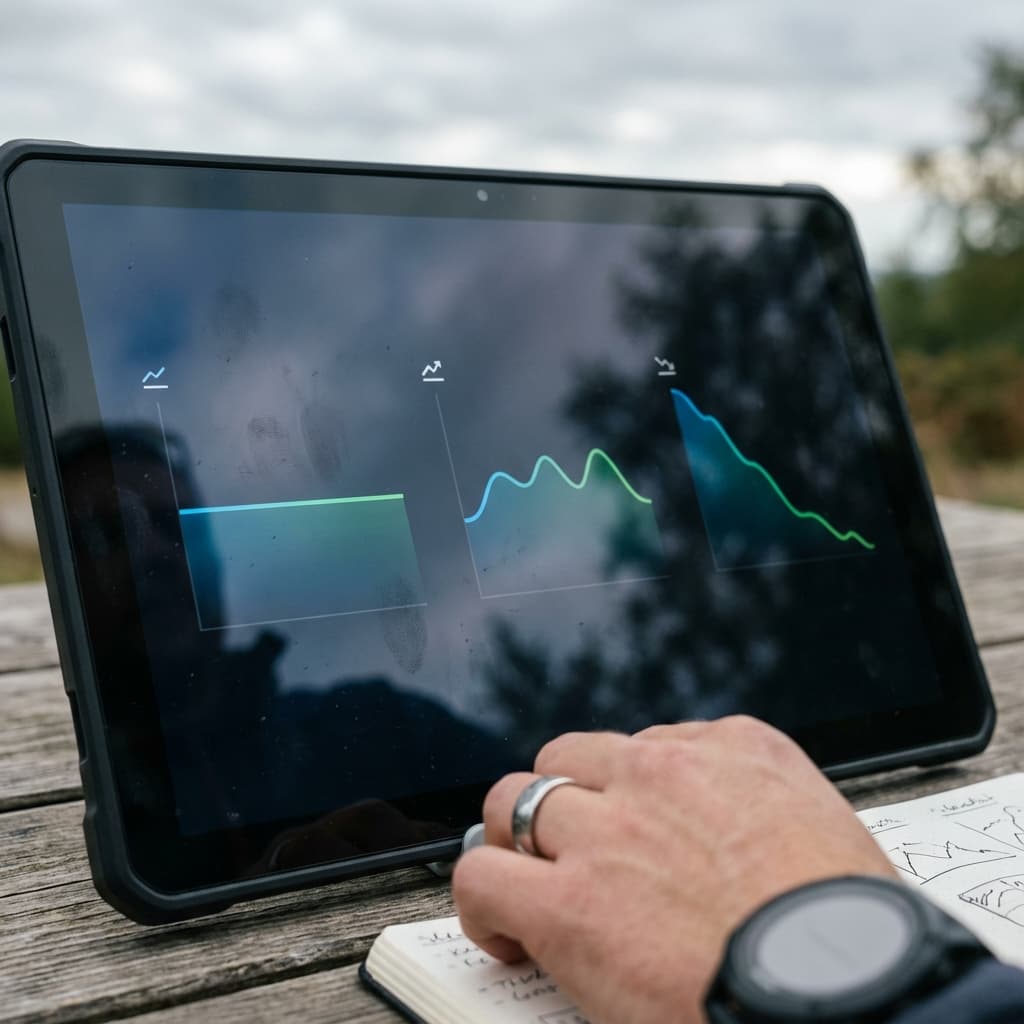
Decoding Marathon Elevation Profiles Marathon elevation profiles tell stories that finish times alone never could. A 3:45 finish on a rolling course means something entirely different than the same time on a pancake-flat route. Understanding these vertical narratives helps you choose races strategically, train appropriately, and pace intelligently on race day. The conventional wisdom suggests flat courses produce faster times. Research from the confirms this, showing that every 1% gradient increase typically costs runners 12-15 seconds per kilometer. But the relationship between elevation and performance proves more nuanced than simple mathematics. ! The Physiology of Vertical Running Uphill running fundamentally changes your biomechanics and energy expenditure. Your body recruits different muscle fibers, shifts from aerobic to anaerobic metabolism earlier, and increases cardiovascular demand significantly. Studies measuring oxygen consumption show runners use 30-40% more energy climbing a 10% gradient compared to flat running at the same pace. Downhill running carries its own penalties. The eccentric muscle contractions required for braking create substantial damage to quadriceps fibers. This explains why runners often feel worse in the final miles of net-downhill courses like Boston or Big Sur compared to flat courses, despite theoretically "easier" terrain. The delayed onset muscle soreness from downhill pounding accumulates through 26.2 miles. When Hills Actually Help Performance Certain elevation profiles benefit specific runner types. Net-downhill courses favor runners with exceptional eccentric strength and quad durability. The historically produces fast times for athletes who train the descent-specific demands. Rolling courses with consistent, moderate grades benefit runners with strong aerobic engines but less raw speed. The varied terrain prevents the monotonous pacing that exposes pure speed limitations on flat courses. Research from European sports scientists shows that runners with high VO2 max values maintain better relative performance on undulating courses compared to runners relying primarily on running economy. Early uphill sections can also serve tactical purposes. Courses like feature initial climbs that force conservative early pacing, preventing the aggressive starts that destroy so many marathon performances. The elevation acts as a natural governor. ! The Hidden Costs of "Fast" Profiles Pancake-flat courses carry their own challenges. Constant, unvarying muscle recruitment patterns create localized fatigue that rolling terrain naturally breaks up. Runners on courses like Chicago or Berlin often report feeling more beaten up in specific muscle groups despite faster finish times. Net-downhill courses present the steepest recovery costs. The eccentric damage from sustained descending requires significantly longer recovery periods than flat or even net-uphill efforts. Athletes targeting quick marathon turnarounds should factor this biological reality into their race selection strategy. Strategic Race Selection Choose your course based on honest self-assessment. Runners with exceptional leg strength and muscular endurance can exploit rolling or net-downhill profiles. Those with superior cardiovascular fitness but less raw power should target flatter courses that reward sustained aerobic output over muscular strength. Consider your goals beyond finish time. PR attempts demand profile-appropriate courses. Boston qualification efforts may benefit from slightly rolling terrain that plays to your specific strengths rather than chasing the flattest available option. The can help you adjust goal times based on elevation profiles, accounting for the vertical reality that raw distance measurements ignore. Training the Elevation Reality Match your training terrain to your target race profile. Runners preparing for hilly marathons need consistent hill repetitions, long runs with sustained climbing, and eccentric strengthening protocols. Those targeting flat courses still benefit from occasional hill work for strength development, but should prioritize sustained tempo efforts on similar terrain to race day. The adaptation period for elevation-specific training requires 8-12 weeks of consistent exposure. Simply adding a few hill sessions in the final month before a mountainous marathon provides insufficient preparation for the biomechanical demands. ! The Verdict on Vertical Elevation profiles matter tremendously, but not uniformly across all runners. Your specific physiology, training background, and race goals determine whether hills help or hurt your performance. The fastest course for you may not be the flattest course available. Study your target race's elevation profile carefully. Train specifically for its vertical demands. Adjust your pacing strategy to account for every climb and descent. The runners who respect elevation's impact consistently outperform those who ignore it. Marathon success requires matching the course to the athlete, not forcing the athlete to race an incompatible profile. Choose wisely, train specifically, and let the elevation work for you rather than against you.

Great Ocean Road Marathon: Running Australia's Most Scenic Coast The morning air in Lorne is cool and salt-tinged. Runners gather at the Surf Lifesaving Club Car Park, stretching beneath eucalyptus trees while the Southern Ocean rolls and crashes just meters away. This is the starting line of the Great Ocean Road Marathon, a 44km point-to-point race that has been held in Victoria, Australia since 2005, stretching from Lorne to Apollo Bay along the coastal route. There's nervous energy, excited chatter in multiple languages, and an unmistakable sense that something special is about to unfold. This isn't just another marathon. It's a journey along one of the world's most spectacular coastal drives, on a road closed to traffic, where the only sounds are footfalls, breathing, and the relentless rumble of waves against ancient limestone cliffs. Running on Australia's Most Famous Road The Great Ocean Road is renowned for its rugged natural beauty, shipwreck stories, and surfing culture, with its frequently changing and dramatic landscapes making this 242-kilometre stretch Australia's most famous coastal journey. But experiencing it as a runner offers something no car passenger can fully grasp: the serenity, the wilderness, the intimate connection to landscape. Anyone travelling along this road by car would not be able to experience the absolute serenity and at times the wilderness experience that you as a runner can. As you run along this course, with no traffic at all, you can almost hear the waves calling your name. The only sound you will hear is the soft thud of footsteps from your fellow competitors. ! The race begins with gentle rollers through the first 6km, allowing runners to find their rhythm and soak in the coastal atmosphere. Then the real character of this course reveals itself. As runners approach the 6-7km mark, a steep descent ushers them towards Cumberland River Beach, introducing the first significant challenge. At the 7km point, the serene beach marks the beginning of three demanding ascents that will test resilience and strength. This is where the Great Ocean Road Marathon earns its reputation. The race has an elevation gain of around 488 metres, with a starting elevation of 17 metres above sea level and a maximum elevation of around 67 metres. The course undulates constantly, presenting runners with climbs that wrap around cliff edges, obscuring their endpoints and demanding both physical strength and mental fortitude. A Course That Tells a Story As the kilometres tick by, runners pass through tiny coastal hamlets: Wye River, Kennett River, Skenes Creek. Starting in Lorne, try spot Koalas as you make your way down the Great Ocean Road through Wye River, Kennett River and Skenes Creek before finishing in Apollo Bay. Each turn reveals new vistas. On one side, the powerful Southern Ocean stretches to Antarctica. On the other, the lush green hillsides of the Otway Ranges rise dramatically. The most challenging section arrives around kilometres 26 and 27. These hills have become legendary among participants, wrapping around cliff faces with no visible end. They sap energy and test resolve. Yet they also offer something profound: moments of pure presence, where nothing exists except breath, movement, and the raw beauty of the Australian coastline. ! Every year, thousands of people cross the globe to experience Australia's most stunning running event and see the iconic beauty of the Great Ocean Road. The 2025 event saw more than 11,000 participants across four sold-out distances, making it one of Australia's premier running festivals. The course eventually flattens as Apollo Bay comes into view in the distance. But the final 7km test weary legs with deceptive miniature climbs. Every slight incline feels magnified. Yet the town draws closer with each stride, and the finish line beckons. Beyond the Marathon The Festival is hosted in the towns of Lorne and Apollo Bay as a weekend-long celebration of running, music and wellness. Festival extras include live music, yoga by the beach, kite flying, wellness sessions, and local food markets. This is destination running at its finest—a reason to explore Victoria's spectacular southwest coast, to linger in charming seaside towns, and to experience the region's natural wonders beyond race day. The offers countless attractions. The Twelve Apostles, those seven limestone stacks rising abruptly from the tempestuous Southern Ocean that are the highlight of the Great Ocean Road, are best viewed at sunset when the yellow rock turns red, orange and every shade in between. Loch Ard Gorge tells stories of shipwrecks and survival. The Great Otway National Park bursts with rainforest walks and cascading waterfalls. ! The Great Ocean Road Running Festival, presented by Melrose, returns on 16-17 May 2026. The event offers multiple distances beyond the marathon, including the 1.5 km Kids' Gallop, 6 km run, 14 km Paradise Run, 23 km half marathon, and the challenging 60 km ultra marathon, alongside trail and walk options. For runners considering this bucket-list event, preparation matters. The elevation profile demands respect. Hill training becomes essential. Yet the reward for that preparation is extraordinary: the chance to run one of the world's most scenic coastal routes, to experience Australia's natural beauty in the most intimate way possible, and to join thousands of runners from around the globe in celebrating movement, landscape, and the pure joy of running beside the sea. The Great Ocean Road calls to runners with the promise of adventure, beauty, and challenge in equal measure. It's a marathon that stays with you long after crossing the finish line—in memories of cliff-edge vistas, in the rhythm of waves that accompanied every step, and in the profound satisfaction of having run one of Australia's most iconic stretches of coast. Start planning your Great Ocean Road Marathon journey today. Find races worldwide, including this spectacular Australian coastal classic, on the , where you can search by location, date, and distance to discover your next running adventure.

Race Week Logistics: Hotels, Packet Pickup & Peace of Mind You've logged the miles. You've dialed in your nutrition. You've visualized crossing that finish line a hundred times. Then race week arrives, and suddenly you're scrambling to figure out where your hotel actually is in relation to the start line, whether you need cash for packet pickup, and if that 6 AM shuttle requires advance booking. Race week logistics can derail months of preparation faster than a missed taper run. The difference between a confident toe line and a frazzled one often comes down to the unglamorous details: proximity to the start, backup alarm strategies, and knowing exactly where you need to be and when. This guide covers the practical logistics that transform race week from chaotic to controlled. Choosing Your Race Week Hotel: Location Trumps Amenities The Instagram-worthy rooftop pool means nothing at 5 AM when you're calculating a 45-minute commute to the start line. Distance to the start line determines everything. A hotel within walking distance (under one mile) eliminates transportation stress entirely. You control your timeline. You avoid crowded shuttles. You can return to your room after the race without waiting in line for an hour. When walking distance isn't possible, prioritize hotels on direct shuttle routes. Most major marathons publish shuttle schedules 2-3 weeks before race day. frequently covers race logistics for major events, but always verify details directly with race organizers. Secondary considerations that actually matter: - Blackout curtains: Poor sleep the night before racing drains performance more than skipping a single long run - Mini fridge: Storing race morning breakfast and recovery drinks beats hoping for convenient options - Early breakfast service: Many hotels offer pre-race breakfast starting at 5 AM for marathon weekends - Parking costs: Factor this into your budget if driving; downtown marathon hotels often charge $30-50 per night ! Book hotels 3-6 months in advance for major marathons. The best-located properties fill quickly, especially for Chicago, Boston, New York, and Berlin. Smaller regional races may offer more flexibility, but waiting until race week limits your options significantly. Packet Pickup Strategy: Timing and What to Bring Packet pickup isn't just grabbing your bib. It's the mandatory pre-race checkpoint that confirms your registration, provides essential race materials, and often serves as your only opportunity to visit the expo. Most races require photo ID and either a confirmation email (printed or digital) or registration number. Some international races require your passport. Check the specific requirements on the race website at least one week before pickup opens. Timing your pickup strategically reduces stress: Early pickup (first day, morning): Shortest lines, full inventory of merchandise, relaxed atmosphere. The downside is making an extra trip if your hotel isn't near the expo location. Mid-window pickup (Friday afternoon for Sunday races): Moderate crowds, most merchandise still available. This timing works well if you're arriving Friday and the expo is convenient to your hotel. Late pickup (Saturday evening): Longest lines, potentially sold-out gear, rushed energy. Only choose this if absolutely necessary due to travel constraints. Never assume you can pick up your packet race morning. The overwhelming majority of races close packet pickup the day before. Missing packet pickup means missing the race, regardless of your training. What to examine at packet pickup: 1. Verify your bib number matches your registration 2. Confirm timing chip is attached (or collect it separately) 3. Review start corral assignment 4. Check bag check tags if applicable 5. Read race day instructions immediately, not the night before The race expo surrounding packet pickup deserves intentional navigation. Sample products you're curious about. Talk to brand representatives about gear questions. But avoid impulse purchases of untested products the day before racing. The new shoe model or revolutionary gel might work brilliantly, or it might cause problems you can't anticipate. Transportation Logistics: Getting to the Start Line Transportation failures create the worst race morning stress. Your Plan A needs a Plan B, and your Plan B needs a Plan C. Walking: The gold standard if possible. No variables, no timing concerns, no crowds. Calculate the walk time and add 50% for race morning congestion. Hotel shuttles: Confirm the schedule in writing at check-in. Ask what time the last shuttle departs, not what time it arrives at the start. Buffer 30-45 minutes for shuttle loading and potential delays. Public transportation: Research exact routes and Sunday/holiday schedules, which often differ from weekday service. Major marathons like publish specific transit information. Download offline maps in case cell service is overwhelmed. Rideshare (Uber/Lyft): Expensive during surge pricing (expect 3-4x normal rates) and unreliable due to road closures. If this is your only option, request your ride 90 minutes before your required arrival time. Driving yourself: Only viable if the race offers participant parking near the start. Otherwise, you're creating a logistics nightmare trying to park in a city with closed roads and then navigating back to your car post-race. ! The Night Before: Practical Preparation Race morning begins the night before. Everything you'll need should be laid out, tested, and ready. Pre-race checklist (actually write this down): - Race bib pinned to singlet/shirt (practice pins; they're stiffer than you expect) - Timing chip attached to shoe (test the strap tension) - Fuel/gels in pockets or belt with tear-away tabs tested - Running watch charged (screen OFF to save battery) - Photo ID and hotel key card in secure pocket - Throwaway warm-up layer for cold starts - Sunglasses, hat, or visor if forecasted sunny - Post-race meeting plan confirmed with supporters Set multiple alarms. Your phone, a backup phone, the hotel wake-up call service. Dead phone batteries happen more often than you think. Plan your race morning meal the night before. Eat what you've practiced during training, not what the hotel buffet recommends. Toast with peanut butter at 2 AM beats fancy hotel pancakes you've never tested. Race Morning Timeline: Work Backward Calculate your race morning timeline by working backward from the start time: - Start time: 7:00 AM - Arrive in corral: 6:30 AM (minimum) - Clear security/bag check: 6:15 AM - Final bathroom stop: 6:00 AM - Arrive at start area: 5:45 AM - Leave hotel: 5:00 AM - Wake up: 4:00 AM Add 15-30 minutes to each transition if you're running a major marathon with 30,000+ participants. This seemingly excessive buffer time prevents the sprint to the start line that spikes your heart rate before mile 1. You cannot start a marathon too relaxed. Post-Race Logistics: Planning Your Exit Post-race logistics receive far less attention than pre-race planning, but matter significantly when you're exhausted and potentially injured. Confirm the bag check process before race morning. Some races use numbered bins, others use checked bags with tags. Know where bag check is located in relation to the finish area. Walking an extra mile in compression socks after finishing sounds manageable until you're doing it. ! Establish specific meeting points with supporters. "Near the finish" doesn't work in a crowd of 10,000 people. Use landmarks: "East side of the park, near the statue, at 11 AM." Build in 30-60 minute flexibility. If you're using public transportation back to your hotel, research the return routes before race morning. Your brain won't function optimally post-marathon. provides comprehensive information about race logistics for marathons worldwide, including transportation and accommodation tips. Plan a real meal for 2-4 hours post-race. Your body needs protein and carbohydrates, not just the free banana and bagel. Research restaurants near your hotel that don't require reservations and accommodate slow-moving, stiff-legged customers graciously. The Mental Game of Logistics Perfect logistics create mental space for performance. When you know exactly where to go, what to bring, and how long each step requires, your mind focuses on racing instead of worrying. Write down your race day plan. Physical writing forces you to think through details that mental planning misses. Review it once before bed, then put it away. Trust your preparation. Logistics failures happen despite perfect planning. Shuttles break down. Roads close unexpectedly. Weather changes everything. The runners who handle these disruptions best are the ones who've eliminated every controllable variable beforehand. Your marathon time won't appear on your logistics planning document, but every minute you spend organizing the details is a minute you'll spend racing confidently instead of managing chaos. Race week logistics aren't glamorous, but they're the foundation of great race day experiences. Handle them well, and you'll toe the line with one thing on your mind: running your best marathon.

The Runner's Complete Guide to Race-Day Fueling: From Training to Finish Line You've logged the miles, conquered the long runs, and fine-tuned your pacing strategy. But here's the hard truth: all that training means nothing if you bonk at mile 20 because you didn't fuel properly. Marathon nutrition can feel overwhelming. Walk into any running store and you're confronted with walls of gels, chews, drinks, and bars, each promising to be the key to your best race. Add in conflicting advice about carb loading, hydration protocols, and fueling windows, and it's enough to make you want to just wing it on race day. Don't. A strategic fueling plan is as essential as your training plan, and getting it right can mean the difference between crossing the finish line strong or crawling through those final miles. Understanding Your Body's Fuel Tank Muscle glycogen provides the key fuel for training and racing a marathon, and carbohydrate loading can enhance performance by allowing you to run at optimal pace for a longer period before fatiguing. Think of glycogen as your body's battery. Your body can store approximately 500g of glucose as glycogen in skeletal muscles and about 100g in your liver. The challenge is this: those stores fuel roughly 90 to 120 minutes of running at marathon pace. Most recreational marathoners are out there for three to five hours. The math doesn't work unless you have a plan to refuel along the way. Research from a 2025 Sports Medicine-Open study of 160 Seville Marathon runners found that those who met carbohydrate intake recommendations during the race (60 to 90 grams per hour) were more likely to finish in under three hours compared to runners who didn't hit those targets. The science is clear: fueling matters. ! The Pre-Race Fueling Window: 2-3 Days Out Modern research shows there's no need to deplete glycogen stores before loading, and carb loading for just 24 to 36 hours is adequate, especially for trained athletes, with 2 to 3 days pre-race being the sweet spot for most recreational marathoners. Forget the old-school depletion phase that left runners exhausted and cranky for days. The current approach is simpler and more effective. Research shows adequate carbohydrates to fully load glycogen stores are 10 to 12 grams per kilogram for 2 days or 8 grams per kilogram for 3 days. For a 70kg (154-pound) runner, that's 560 to 840 grams of carbohydrate per day during the loading phase. What does that actually look like on your plate? More than you think. You'll need to prioritize carbohydrate-rich foods at every meal and snack. Research published in the Journal of Applied Physiology shows you should focus on fast carbohydrates, refined sugars, white rice, and starches that digest easily, with white bread, pasta, potatoes, and rice as go-to foods. Yes, that means temporarily swapping your usual whole grains for refined carbs. Low fiber and low fat options are ideal for carb loading before a marathon because avoiding high fiber and high fat options aids digestion and means you can eat the large volume required without feeling too full. Practical Carb Loading Tips: - Spread your intake throughout the day (three meals plus three snacks) - Consider making lunch your largest meal the day before an early morning race - Drink some of your calories (sports drinks, juice, lemonade) - Stay well hydrated (carb loading requires extra fluids) - Accept that you'll gain 1 to 2kg of water weight (this is normal and beneficial) Race Morning: The Final Top-Up Aim for at least 100 grams of carbohydrates for breakfast, eaten 3 to 4 hours before the start, though 2 to 3 hours before might work if you don't suffer from gastrointestinal distress. This meal replenishes liver glycogen depleted during your overnight fast. Your breakfast should be familiar, tested multiple times during training, and easy to digest. Popular choices include bagels with jam, oatmeal with honey, white toast with banana, energy bars, or even rice with a bit of salt. Bring a water bottle to sip and a gel to take in the 15 minutes before the race starts. That pre-race gel will become available energy about 30 to 45 minutes into your run, right when you need it. ! During the Race: Fueling for Performance This is where your strategy becomes critical. The general recommendation is to consume 30 to 60 grams of carbohydrates per hour, which could include two one-ounce bags of sport beans or two energy gels. Your body can comfortably absorb a maximum of 60 to 90 grams of carbohydrates per hour, with elite runners often targeting the higher end. Timing Your Fuel Intake For most people, start fueling 30 to 45 minutes into the run to get a head start on your glycogen storage. Don't wait until you feel tired. By then, you're already behind and playing catch-up is nearly impossible. Studies suggest taking 25 to 30 grams of carbohydrate (the equivalent of one energy gel) every 30 to 45 minutes. Some runners perform better taking smaller amounts more frequently, every 15 to 20 minutes. This is individual and requires practice. Energy Gel Essentials: How they work: Energy gels are essentially liquid carbohydrates, most based on maltodextrin made from corn starch combined with fructose, which are simple sugars that bodies can digest quickly. How many you need: For a half marathon (1.5 to 2.5 hours), plan for 2 to 4 gels spaced 30 to 45 minutes apart, while marathons (3 to 5 hours) require 4 to 8 gels depending on your fueling needs and tolerance. Practical considerations: Mix your sources. Combining gels with sports drinks can help you absorb more carbohydrates and prevent flavor fatigue. Calculate your total needs based on your projected finish time and bring extras in case the race doesn't go as planned. Hydration: The Other Half of the Equation For most runners, aim for 60 to 90 grams of carbohydrates per hour, 200 to 500mg of sodium per hour, and 5 to 10 ounces of fluids every 15 minutes during races over one hour. Hydration and fueling work together. Dehydration can worsen stomach issues and reduce gel effectiveness, so sip water regularly. Sports drinks serve double duty, providing both hydration and carbohydrates. Factor this into your total carb intake so you don't exceed your body's absorption capacity. The Golden Rule: Practice During Training Practicing fueling techniques on long runs prior to your race is critically important because you need to figure out what your stomach can handle and use your long runs as trial workouts, never introducing anything new when you toe the line. Your gut needs training just like your muscles. You want to train your gut to digest carbohydrates during running, as trying to eat while running for the first time in a race scenario can cause stomach and gut upset. Start experimenting with nutrition at least 10 weeks before your race. Try different products, test various timing protocols, and simulate race conditions during your long runs. Some runners tolerate gels beautifully. Others do better with chews, waffles, or even real food. There's no single right answer, only what works for your system. Testing Protocol: 1. Weeks 10-8: Try different products on easy runs 2. Weeks 7-5: Practice your planned fueling schedule on long runs 3. Weeks 4-2: Fine-tune timing and amounts at marathon pace 4. Race week: Stick with what you know works Check your race's website or contact organizers to learn what will be available at aid stations. Many races supply water, Gatorade, and gels at different aid stations, so check if there's a course map that tells you what's available and where to figure out what you need to carry versus what you can grab at aid tables. ! Common Fueling Mistakes to Avoid Overcomplicating it: Your fueling strategy should be simple enough to execute when you're tired and your brain is foggy at mile 18. Trying something new on race day: This applies to everything from the brand of gel to the flavor to the timing. Race day is for execution, not experimentation. Forgetting about caffeine: Research shows caffeine can increase alertness and increase time to exhaustion. If you're a regular caffeine user, plan when you'll take caffeinated gels (many runners save these for the second half). Ignoring your body's signals: Guidelines are starting points. Some runners need more fuel, some need less. Pay attention during training and adjust accordingly. Underfueling because you're worried about stomach issues: Athletes who met carbohydrate intake recommendations during competition (60 to 90 grams per hour) were more likely to finish the marathon in less than 180 minutes. The risk of bonking is greater than the risk of minor GI discomfort. Building Your Personal Fueling Plan Every runner's plan will look slightly different based on body weight, running pace, stomach tolerance, and personal preferences. Here's a framework to build yours: Calculate your hourly needs: Target 60 to 90 grams of carbohydrate per hour for most recreational marathoners. Choose your products: Select 2 to 3 options you've tested thoroughly (gels, chews, drinks). Map it to your race: If you run 10-minute miles, fuel every three miles. Faster runners can use 4 to 5-mile intervals or set your watch to beep every 30 to 45 minutes. Account for aid station logistics: Know where stations are located and what they offer. Pack strategically: Carry what you need in a way that's comfortable and accessible. If you're looking for races to test your fueling strategy, the offers a comprehensive global database of marathons searchable by location, date, and distance, helping you find the perfect training races leading up to your goal event. Final Thoughts Marathon fueling isn't rocket science, but it does require planning, practice, and a willingness to learn what works for your unique physiology. The runners who nail their nutrition strategy don't just survive the final miles. They own them. Start building your fueling plan now, test it relentlessly during training, and trust it on race day. Your legs might get tired, but with proper fueling, you'll never have to experience that empty-tank, can't-take-another-step feeling of bonking. The marathon is hard enough. Don't make it harder by showing up with an empty fuel tank. Further Reading - - - - -
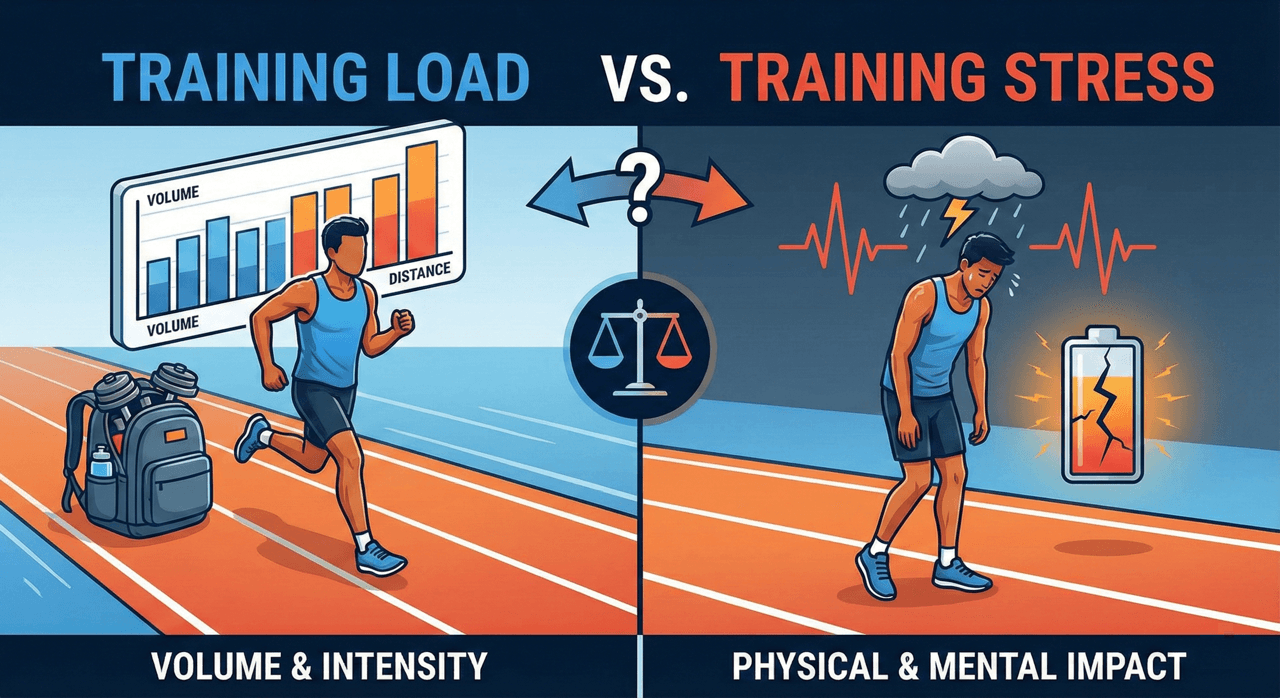
Training Load vs. Training Stress: What Runners Need to Know Your watch says you're recovered. Your legs say otherwise. This disconnect happens because modern running analytics track two fundamentally different metrics that runners often confuse: training load and training stress. Understanding the distinction between these measurements can transform how you approach marathon preparation, recovery planning, and race day performance. The Core Difference: What Load and Stress Actually Measure Training load quantifies the work you're doing. It's an objective measure of volume and intensity combined into a single number. Think of it as the mechanical stress you're placing on your body through distance, pace, and effort. Training stress, by contrast, measures your body's response to that work. It incorporates physiological signals like heart rate variability, resting heart rate, sleep quality, and perceived fatigue. This metric attempts to capture the biological cost of your training. Consider two runners logging identical weekly mileage at similar paces. Runner A sleeps eight hours nightly, eats well, and manages work stress effectively. Runner B gets five hours of sleep, skips meals, and battles a demanding deadline. They share the same training load. Their training stress diverges dramatically. How Training Load Is Calculated Most running platforms calculate training load using variations of the Training Impulse (TRIMP) method, developed by exercise scientist Eric Bannister in the 1970s. The basic formula multiplies training duration by intensity, then applies a weighting factor based on heart rate zones or perceived effort. A simplified version looks like this: Training Load = Duration × Intensity Factor. A 90-minute easy run at 65% max heart rate generates less load than a 60-minute tempo run at 85% max heart rate, even though the tempo run is shorter. The intensity weighting makes the difference. Platforms like Strava, Garmin, and Polar each use proprietary algorithms, but the underlying principle remains consistent. They're measuring the stimulus you're applying, not how your body processes that stimulus. Recent research published in the Journal of Applied Physiology found that training load calculations correlate strongly with performance improvements when monitored over 12-week training blocks. Runners who gradually increased their weekly training load by 10-15% showed better race outcomes than those with erratic load patterns. Understanding Training Stress: The Body's Response Training stress metrics attempt something more ambitious. They want to quantify recovery need, injury risk, and readiness to train hard again. Garmin's Training Status uses a combination of acute training load (last week), chronic training load (last month), and heart rate variability to generate categories like "Productive," "Maintaining," or "Overreaching." Whoop calculates a Recovery Score using HRV, resting heart rate, respiratory rate, and sleep data. These metrics incorporate variables beyond your control during runs. Poor sleep tanks your training stress score even if you didn't run that day. A stressful work presentation elevates your resting heart rate, signaling reduced readiness. The critical insight here involves recognizing that training stress reflects total life stress, not just running stress. Your body doesn't compartmentalize. The cortisol from a bad night's sleep affects your muscle recovery just like the cortisol from a hard interval session. ! The Acute-Chronic Workload Ratio: Bridging Both Concepts One of the most useful frameworks for marathon runners combines elements of both load and stress: the Acute-Chronic Workload Ratio (ACWR). ACWR compares your recent training load (typically the last week, called acute load) against your longer-term average (usually four weeks, called chronic load). The ratio reveals whether you're ramping up training faster than your body can adapt. Research across multiple sports, including a comprehensive study of over 2,000 athletes published in the British Journal of Sports Medicine, suggests that an ACWR between 0.8 and 1.3 represents the "sweet spot." Below 0.8, you're potentially detraining. Above 1.3, injury risk increases substantially. Here's what this looks like in practice. Imagine your average weekly training load over the past month is 400 training load units. This week, you logged 480 units. Your ACWR is 1.2, which falls within the optimal range. Your body has sufficient chronic training load to handle the acute spike. Now imagine your chronic load is 300 units and you suddenly jump to 450 in one week. Your ACWR hits 1.5. You've outpaced your body's adaptation capacity, even though the absolute load isn't excessive. Many running platforms now include ACWR or similar metrics. can help you track these ratios and plan appropriate training progressions. Practical Applications for Marathon Training Understanding the load-stress distinction changes how you structure training blocks. Use training load for planning progressive overload. When designing your 16-week marathon buildup, focus on gradually increasing weekly training load by 10-15%. This ensures systematic progression that challenges your aerobic system without overwhelming it. Use training stress for daily training decisions. Your watch shows low HRV and elevated resting heart rate? That's high training stress signaling reduced readiness. Convert today's planned tempo run into an easy aerobic effort, maintaining training load while respecting physiological stress. Monitor the gap between load and stress. When training load increases but training stress remains manageable, you're adapting well. When load stays constant but stress climbs, external factors are compromising recovery. You need more sleep, better nutrition, or stress management, not different workouts. Pay attention to non-running stressors. A demanding work week, poor sleep, or relationship stress all elevate training stress without adding training load. During these periods, you may need to reduce training volume by 20-30% to maintain the same total stress level. Common Mistakes Runners Make The most frequent error involves treating training stress scores as definitive judgments rather than informational signals. Your watch says you're recovered, but your legs feel heavy. Trust your legs. The watch captures useful data points but can't fully assess your readiness. Another mistake involves chasing training load numbers without considering training stress. Hitting your planned weekly mileage matters less than accumulating that mileage while maintaining manageable stress levels. A runner who completes 85% of planned training load with low stress will outperform someone who hits 100% while chronically overstressed. Some runners make the opposite error, obsessing over stress metrics and pulling back from planned training whenever scores look suboptimal. Training requires stress. The goal involves applying appropriate stress that stimulates adaptation, then allowing adequate recovery. Perfect readiness isn't the objective. Progressive adaptation is. ! Integrating Both Metrics Into Your Training The most effective approach uses training load for macro planning and training stress for micro adjustments. Start your training cycle by mapping out progressive load increases week by week. Use historical data or established guidelines. A runner averaging 50 miles weekly might plan to build toward 70 miles over 12 weeks, adding 5-10% load weekly. Within that framework, let training stress guide daily decisions. High stress with a hard workout scheduled? Shift the workout back a day and insert an easy run. Low stress after a rest day? Proceed with confidence. Monitor the relationship between the two metrics weekly. Training load increasing while stress remains stable indicates positive adaptation. Load stable but stress climbing suggests inadequate recovery or non-running stressors requiring attention. External research from the European Journal of Applied Physiology tracking 50 marathon runners through 16-week training blocks found that runners who adjusted training based on both load progression and daily stress metrics showed 23% fewer overuse injuries compared to runners following rigid plans. The Bottom Line Training load tells you what you're doing to your body. Training stress tells you what your body thinks about it. Both metrics provide valuable information, but neither tells the complete story alone. Training load helps you plan systematic progression. Training stress helps you execute those plans while respecting your body's current capacity. The smartest approach involves planning your training around progressive load increases, then making daily adjustments based on stress signals. This combination ensures you're challenging your aerobic system appropriately while allowing adaptation to occur. Your marathon performance depends not on accumulating the highest possible training load, but on accumulating sufficient load while managing training stress effectively. The runners who master this balance show up on race day with developed aerobic systems and fresh legs. That's the real advantage of understanding these metrics. You stop training randomly and start training strategically, applying appropriate stress that drives adaptation without breaking down your body. You learn to distinguish between challenging yourself and overwhelming yourself. The goal involves getting stronger, not just doing more. These metrics help you tell the difference.
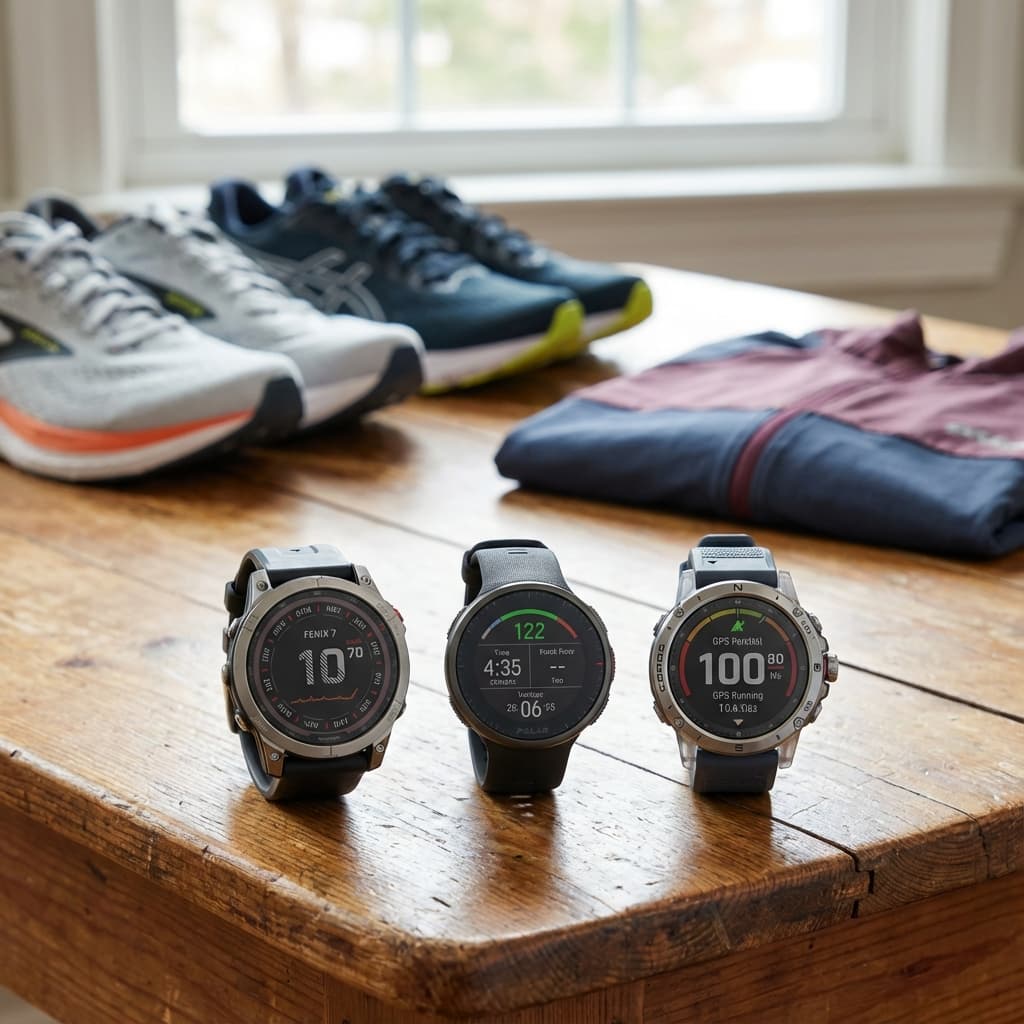
Garmin vs. Polar vs. COROS: Which Running Watch for Marathon Training? Standing in a running specialty store, staring at three nearly identical GPS watches with wildly different price tags, you might wonder which brand deserves your training budget. Garmin, Polar, and COROS all occupy different positions in the running watch market, with COROS generally positioning itself as a more budget-friendly option, with most watches falling in the $200-$700 range</cite>, while Garmin running watches range in price from around $150 to over $1,200</cite>. Polar sits somewhere in between, focusing heavily on heart rate accuracy and recovery metrics. All three brands build reliable GPS watches that can track your marathon training. The real differences emerge when you examine what each brand does best and where they make compromises. What Garmin Does Best Garmin owns the largest market share for good reason. The company produces an enormous range of watches, from the Forerunner 55, which delivers rock-solid GPS, wrist-based heart rate, daily suggested workouts, and recovery time at $150, to flagship models costing well over $800. Garmin continues to dominate when it comes to accuracy, training depth, and ecosystem strength. The Garmin Connect app stands out as the most comprehensive training platform among the three brands. You get detailed analytics, training status indicators, suggested workouts that adapt to your fitness level, and Garmin Coach, which offers free adaptive training plans available in the app for 5K, 10K, or half marathon distances. The mid-range models like the Forerunner 265 offer Garmin's brightest and sharpest AMOLED touchscreen display yet, plus training status, training readiness and performance condition features. Battery life ranges from 19 hours of GPS runtime on the Forerunner 165 to 26 hours on the Forerunner 255, with smartwatch mode lasting days to weeks depending on the model. For marathon runners, Garmin watches excel at pacing strategy. PacePro is Garmin's built-in pacing tool that's useful for hilly marathons like Boston, creating a pacing plan that takes into account the amount of uphill or downhill in each mile or kilometer split. ! Where Polar Shines Pioneers of heart rate tracking, Polar still makes some of the very best heart rate monitors going. The Finnish company built its reputation on cardiac monitoring accuracy, and that heritage shows in every watch they produce. The Polar Vantage series and newer models like the Grit X2, which features a slimmer profile, lighter weight, and a 1.28-inch AMOLED display protected by sapphire crystal</cite>, deliver professional-grade biosensing. These watches feature 4th-generation optical heart-rate tracking, wrist-based ECG, SpO₂ sensing and skin temperature tracking. Polar's training philosophy centers on recovery and readiness. The Nightly Recharge, Training Load Pro and Orthostatic Test help you understand how your body is adapting, when to train hard and when to rest. This approach makes Polar watches particularly valuable for runners prone to overtraining or those balancing high training loads with demanding schedules. The Polar Pacer Pro offers good value as a mid-range option with great GPS, even if the LCD screen is a bit bare-bones. At launch, the COROS Pace Pro was priced at $349, which is $100 cheaper than the Garmin Forerunner 265 at $449 and $50 cheaper than the Polar Vantage M3 at $399.95. The Polar ecosystem works well for runners who want deep health insights without drowning in metrics. The interface tends toward simplicity compared to Garmin's feature-dense approach. The COROS Value Proposition COROS entered the GPS watch market later than its competitors but quickly earned respect among endurance athletes. The big thing that sets COROS apart from competitors is the insane battery life, a scroll button, and the willingness to constantly innovate and develop its software. The COROS Pace 4 offers impressive features at approximately $249. In max GPS mode with all satellite systems active, the Pace 4 delivers 31 hours of battery life, and if you leave the screen set to 'always on', that figure lowers to 24 hours</cite>. These numbers dramatically exceed what you get from comparably priced Garmin or Polar models. ! The Pace 4's range of advanced running analytics is impressive for the price. You get the same suite of Evo Lab training tools as the pricier Apex, including Running Performance, Training Load with a week overview, recovery time recommendations, running fitness scores and pace ranges</cite>. The trade-off comes in smartwatch features. COROS watches are a bit short on smartwatch skills. Garmin does this better</cite>. COROS lacks NFC payment options, doesn't support Spotify streaming (only MP3 music storage), and offers fewer third-party app integrations. For runners who care primarily about training data and battery endurance rather than lifestyle features, COROS delivers exceptional value. If you prioritize battery life, reliable GPS, excellent mapping, rugged durability, and handy hardware controls over a pretty screen, COROS watches are among the best performing of 2025. GPS Accuracy and Heart Rate Performance All three brands now offer multi-band, dual-frequency GPS on their mid-range and premium models. In testing, the dual frequency GPS on COROS watches performed well against pricier Garmin models for total distances. Real-world accuracy differences between brands have narrowed considerably. Heart rate accuracy tells a more nuanced story. Garmin watches stress-tested against a Polar H10 heart rate monitor (the most accurate way to measure heart rate available to most people during a workout) showed accuracy within 1 beat per minute</cite> on premium models. COROS heart rate was more hit and miss during interval sessions with some big spikes, at times reading 20bpm higher than a chest strap. Polar's optical heart rate sensors generally perform well, though no wrist-based sensor matches the accuracy of a chest strap during high-intensity intervals. For steady-state marathon pace running, all three brands deliver reliable heart rate data. Battery Life Reality Check Without music, a 4-hour marathon burned 21% battery on the Garmin Forerunner 165, meaning the watch easily handles race day. COROS Apex 4 offers 65 hours GPS time from the 46mm version or 41 hours from the 42mm, which exceeds most marathon runners' needs by a significant margin. Polar lists the Grit X2 at up to 90 hours in Eco training mode, 30 hours in Performance mode, and about a week in Smartwatch mode. These figures mean you can train for an entire week, including a long run, without reaching for a charger. Battery life matters most for ultrarunners and those who forget to charge their watches. For standard marathon training, all three brands offer sufficient endurance. Training Features and Ecosystem Garmin's training ecosystem remains the most comprehensive. The platform includes structured workouts, race predictors, training load tracking, recovery advice, and performance condition indicators. The data can feel overwhelming for new runners but becomes invaluable as you develop as an athlete. Polar focuses on recovery and readiness metrics, which helps prevent overtraining. The company's approach to training load and recovery feels more conservative than Garmin's, which some runners appreciate. COROS training tools have improved dramatically through software updates. If you have a COROS watch, you'll continuously experience new features being added, making your watch better and better. The training metrics now rival what Garmin offers, though the app interface remains less polished. The Verdict: Which Watch Should You Buy? For most marathon runners, the COROS Pace 4 at $249 represents the best value. You get accurate GPS, comprehensive training metrics, exceptional battery life, and a bright AMOLED display for half the cost of premium competitors. The limitations in smartwatch features and music streaming won't matter if you care primarily about training data. If you want the most complete training ecosystem and don't mind spending more, the Garmin Forerunner 265 at a discounted price (often $100-150 off) brings a stunning AMOLED screen, multi-band GPS, and advanced training metrics to the masses. Garmin's extensive feature set and refined app make it the safe, comprehensive choice. Polar deserves consideration if you prioritize heart rate accuracy and recovery insights above all else. The Polar Vantage M3 or Pacer Pro deliver professional-grade biosensing at reasonable prices, though you'll sacrifice some battery life and pay slightly more than equivalent COROS models. The right watch depends on your priorities. COROS wins on value and battery life. Garmin offers the most complete package with the best ecosystem. Polar excels at recovery tracking and heart rate monitoring. All three will accurately track your miles and help you reach the marathon finish line. Further Reading: - (Runner's World) - (James T Rodgers) - (Runner's World) - (Find your next marathon) - (iRunFar) - (The Run Testers) - (42cal Blog)

The Runner's Holiday Survival Guide: Stay Training-Ready The alarm goes off at 5:30 AM on December 27th. You're sleeping in your childhood bedroom, three time zones away from home, and your training plan says you need to knock out 18 miles today. Your mother has leftover pie for breakfast. Your old running shoes are back home because luggage space was tight. The spring marathon you registered for in October suddenly feels very far away. This scenario plays out in thousands of households every holiday season. You've committed to a race that seemed achievable in autumn, but now you're navigating family obligations, travel logistics, shorter days, colder weather, and tables laden with food that calls to you at every turn. The holidays present a unique challenge for runners training through winter, particularly those targeting early spring races like Boston, London, or Tokyo. The good news is this: you can maintain meaningful fitness through the holidays without becoming the family pariah who disappears for two-hour runs or refuses every dessert. The key lies in strategic flexibility, not rigid adherence to plans written months ago. Understanding the Holiday Training Reality First, accept that your training during a two to three-week holiday period will look different than your regular routine. This isn't failure. It's adaptation. Consider the typical disruptions. You might be traveling across time zones, sleeping in unfamiliar beds, and dealing with weather conditions you haven't trained in. Your usual 6 AM run slot might conflict with family breakfast traditions. The route you'd normally run doesn't exist at your in-laws' house. Your gym access disappears. Your carefully planned meal timing gets thrown off by irregular family dining schedules. Research from the Journal of Applied Physiology shows that trained runners can maintain aerobic fitness for up to three weeks with significantly reduced training volume, provided they maintain some intensity. Your body doesn't forget how to run because you miss a few workouts or reduce your weekly mileage by 30 percent for two weeks. The psychological challenge often exceeds the physical one. Runners tend toward perfectionism, and holidays create situations where perfect adherence becomes genuinely impossible. The sooner you make peace with good enough, the less stress you'll carry. The Pre-Holiday Training Strategy ! Your holiday survival actually begins two weeks before you travel. Build a buffer into your training plan. If your schedule calls for a key workout during holiday week, complete it the week before instead. Move your 20-miler to the weekend before Thanksgiving rather than the weekend after. Banking quality work provides mental peace and physical preparation that carries you through disrupted weeks. Run slightly higher mileage in the two weeks preceding travel. If you typically run 45 miles weekly, push to 50 or 52. This creates physiological momentum that sustains you when volume drops. Think of it as building a fitness cushion. Pack your running gear first, not last. Include multiple outfit options because weather can shift unexpectedly. Bring a headlamp, reflective vest, and layering pieces. If you're traveling somewhere cold, check before you leave. Pack fuel for long runs because finding your preferred nutrition in unfamiliar locations proves surprisingly difficult. Research running routes at your destination before arrival. Websites like MapMyRun and Strava's route finder show popular running paths. Check if your hotel has a gym with a treadmill as a backup option. Identify the closest running store in case you need emergency supplies. Flexible Training Frameworks That Actually Work Abandon the idea of maintaining your exact training schedule. Instead, commit to three non-negotiable principles during holiday weeks. Principle One: Maintain three quality sessions weekly. These sessions preserve your aerobic capacity and running economy. One should include tempo work, one should be your long run (even if shortened), and one should maintain your threshold pace. Everything else becomes optional. A realistic holiday week might look like this: Tuesday, 45-minute easy run with 15 minutes at tempo pace. Thursday, 60-minute progression run building to marathon pace for the final 15 minutes. Saturday, 90-minute long run at easy pace. Total weekly volume drops to perhaps 25 to 30 miles instead of your planned 50, but you've preserved the stimulus that matters most. Principle Two: Consistency beats volume. Running five days at reduced mileage maintains your routine better than trying to cram your full weekly volume into three massive efforts. Your body adapts to regular stimulus, not sporadic heroics. If you normally run six days weekly, aim for four or five during holidays. Reduce each run by 20 to 30 percent. A typical 10-mile midweek run becomes seven miles. Your body maintains conditioning while accommodating reduced recovery time from travel stress and irregular sleep. Principle Three: Time-based training provides more flexibility than mileage-based training. When you're running unfamiliar routes or dealing with challenging weather, focusing on time rather than distance reduces pressure and allows natural pace adjustments. Instead of committing to eight miles, commit to 55 minutes of running. You might cover different distances depending on terrain or conditions, but you've achieved the training effect. This mental shift proves surprisingly liberating. Navigating Holiday Food Without Sabotaging Training ! Holiday food presents a genuine challenge. You're burning significant calories through training, family expects you to participate in traditional meals, and restriction creates social tension while potentially undermining your energy availability. The solution involves permission and boundaries working together. Permission first. You can enjoy holiday foods. Your training actually requires substantial caloric intake. A runner training 40 to 50 miles weekly needs roughly 2,800 to 3,500 calories daily depending on body size and intensity. Holiday meals, even indulgent ones, fit within this framework when balanced against your training load. Practical approach: eat normally at holiday meals. Take reasonable portions of foods you genuinely want. Enjoy dessert. Then return to your regular eating pattern the next day. One celebratory dinner doesn't derail months of training. Three weeks of daily excess might. The boundary comes in daily habits around special occasions. Maintain your normal breakfast routine (this often means eating before family gathers). Keep healthy snacks available (bring your own if needed). Stay hydrated consistently. Limit alcohol because it genuinely impairs recovery and sleep quality, both critical during compressed training periods. Avoid the post-meal guilt run. Running immediately after large meals as punishment creates unhealthy relationships with both food and exercise. Trust your training to utilize the fuel. Your long run later in the week will appreciate the glycogen stores. One practical tip from sports nutritionists: prioritize protein at holiday meals. The turkey, ham, or roast contains nutrients your recovering muscles need. Loading your plate with protein-rich foods naturally reduces room for less nutrient-dense options while supporting your training adaptation. Managing Time Zone Changes and Sleep Disruption Travel across time zones affects training more than most runners anticipate. Your circadian rhythm governs hormone release, body temperature, and metabolic function, all of which impact running performance and recovery. When traveling east (harder adjustment), arrive a few days early if possible. Start shifting your sleep schedule three days before travel by going to bed 30 minutes earlier each night. Upon arrival, immediately adopt local meal and sleep times. Get morning sunlight exposure to reset your internal clock. When traveling west (easier adjustment), you can typically maintain your normal schedule with minor tweaks. Early morning runs become easier because your body thinks it's later. If you're only traveling for four to five days, some coaches recommend maintaining your home schedule rather than adjusting. Keep your watch on home time, run when your body expects to run, and eat when your metabolism expects food. This works surprisingly well for short trips. Sleep quality matters more than sleep quantity for training adaptation. Prioritize consistent sleep schedules over trying to bank extra hours. Use earplugs, eye masks, or white noise apps when sleeping in unfamiliar environments. Avoid alcohol before bed despite social pressure, as it significantly degrades sleep quality and recovery. If jet lag leaves you genuinely exhausted, consider making that day's run easy and short rather than skipping it entirely. Twenty minutes of easy running often improves energy and helps circadian adjustment better than staying sedentary. When Weather Forces Plan Changes Winter weather creates genuine safety concerns that trump training plans. Ice, extreme cold, or darkness in unfamiliar areas warrant alternative approaches. Identify treadmill options before emergencies arise. Many hotels, local gyms, and university recreation centers offer day passes. Yes, treadmill running feels monotonous. It's still better than skipping your long run or risking injury on icy roads. Make treadmill long runs manageable through variation. Run the first 30 minutes at easy pace, then do 10-minute intervals alternating between marathon pace and easy pace. The mental engagement helps time pass. Watch a show or listen to podcasts you save specifically for treadmill sessions. If you absolutely cannot run outdoors or access a treadmill, cross-training maintains cardiovascular fitness better than nothing. Sixty minutes on a stationary bike or elliptical provides aerobic stimulus even though it doesn't replicate running's biomechanical demands. This approach works for a few sessions but shouldn't replace more than two or three runs in a training block. Extreme cold requires specific preparation but doesn't necessarily prevent running. Temperatures above 10°F (minus 12°C) allow safe running with proper layering and exposed skin protection. Check before heading out. Start runs into the wind so you return with wind at your back when you're sweating. The Art of the Abbreviated Long Run Your long run represents the most important training element for marathon preparation. Holiday weeks often make your planned long run impossible at full distance, but partial completion provides significant value. Running 75 to 80 percent of your planned long run distance maintains the aerobic stimulus your body needs. If your schedule calls for 20 miles but circumstances limit you to 15, you've still achieved meaningful adaptation. The physiological difference between 15 and 20 miles matters far less than the difference between 15 and zero. Split long runs across two days work better than you might expect. Run 10 miles Saturday morning and 10 miles Sunday morning instead of 20 miles Saturday. While not identical to single long efforts, back-to-back runs challenge your body to manage fatigue and train your legs for cumulative stress. Many ultramarathon training plans incorporate this deliberately. Start your long runs earlier than usual during holidays. Running at 6 AM before family activities begin creates less schedule conflict than trying to squeeze in afternoon runs between meals and gatherings. Early runs also mean cooler temperatures and quieter streets if you're running in unfamiliar locations. Consider running your long run on Christmas Eve or the day before major gatherings rather than the holiday itself. Most families have fewer structured activities the day before celebrations, giving you more scheduling flexibility. Returning to Normal Training The week after holidays require gradual reentry, not immediate resumption of peak training volume. If you reduced your mileage by 30 to 40 percent during holiday weeks, rebuild by adding 10 to 15 percent weekly. Running 30 miles during holiday week when you normally run 50 means returning to 35 miles your first week back, then 40, then 45, before resuming your full training plan. This prevents the injury spike that occurs when runners try immediately returning to previous volume. Your first workout back should feel controlled rather than aggressive. Use it to assess your current fitness level rather than prove something. You might be surprised by how well you've maintained conditioning with reduced volume. If you gained a few pounds during holidays, trust your training to gradually address it. Immediately restricting calories while ramping training volume creates energy deficit that impairs adaptation and increases injury risk. Your body will naturally adjust over several weeks as you return to regular patterns. The runners who successfully navigate holiday training periods share a common trait: they release attachment to perfect adherence. They maintain enough structure to preserve fitness while allowing enough flexibility to enjoy seasonal experiences. Final Thoughts: Permission to Be Human Spring marathons often require training through the most socially demanding time of year. December and early January bring family obligations, travel complications, and cultural expectations around food and celebration that conflict with training demands. You don't need to choose between being a dedicated runner and a present family member. Those represent false alternatives created by all-or-nothing thinking. You can run meaningfully while traveling. You can maintain fitness while eating holiday meals. You can preserve your training trajectory while adjusting your plan. The runners who reach their spring marathons in good condition aren't the ones who never deviate from their schedules. They're the ones who adapt intelligently while maintaining consistency in what matters most. Track your holiday training on to maintain accountability without rigidity. The platform helps you see the bigger picture of your training progression rather than fixating on individual missed workouts. When you return to full training in January, you'll have maintained enough fitness to rebuild quickly toward your spring race goals. The holidays last a few weeks. Your running life spans decades. Keep perspective, stay consistent where possible, and give yourself permission to be fully human during this season. Your spring marathon will arrive soon enough, and you'll be ready.
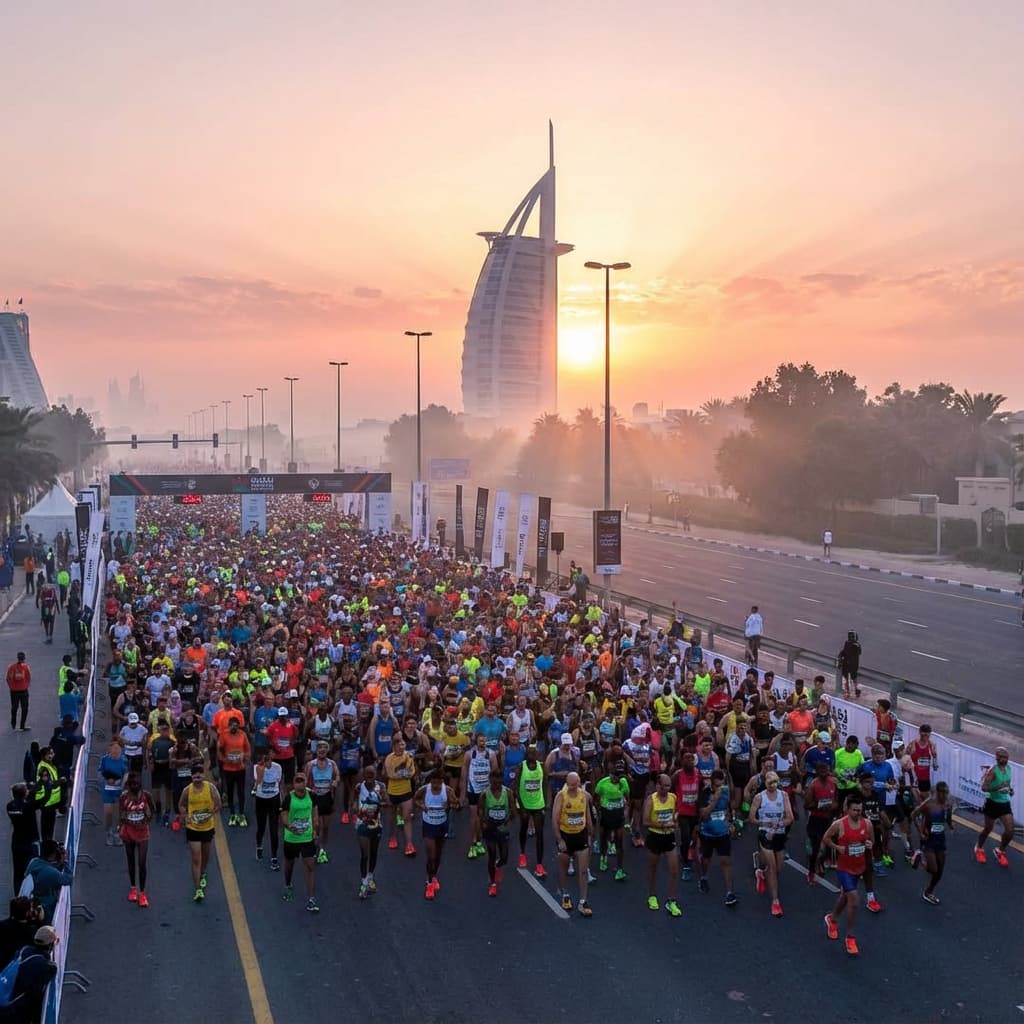
Dubai Marathon: Chasing Fast Times Under Desert Stars It's 6:30 AM on a January morning in Dubai, and the air along Umm Suqeim Road hums with quiet anticipation. The sky shifts from indigo to soft pink, and there, silhouetted against the dawn, stands the Burj Al Arab. Thousands of runners gather in its shadow, their breath visible in the rare cool air. This is the Dubai Marathon, and the city that never seems to slow down is about to witness some of the fastest times in marathon running. Dubai has earned a reputation for superlatives. The tallest building, the largest malls, the most ambitious infrastructure projects. But beyond the gleaming towers and engineered islands lies something more genuine: a thriving community of athletes, a city that transforms into a runner's paradise during the winter months, and a marathon that consistently produces world-class performances on one of the fastest courses on the planet. A Course Built for Speed The Dubai Marathon course records stand at 2:03:34 by Geteneh Molla and 2:16:07 by Tigist Ketema, establishing it as one of the fastest marathons in the world.These aren't outliers. The average of the top 10 men's performances in Dubai is 2:04:02, surpassed only by Berlin, Valencia, London, Tokyo and Chicago, while the average of the top 10 women's times is 2:18:36. The numbers tell part of the story, but they don't capture what it feels like to run this course. The route starts near Madinat Jumeirah, heads along Al Sufouh past the entrance to Palm Jumeirah, then continues on Jumeirah Beach Road past the Burj Al Arab and Jumeirah Beach Hotel. It's flat, fast, and designed with one purpose: helping runners achieve their dreams. ! The course follows an out-and-back format that some might find repetitive, but seasoned marathoners understand the advantage. You know exactly what's coming. There are no surprises, no hidden climbs at mile 20, no cobblestones or tight turns. Just smooth asphalt, the sound of the ocean nearby, and the steady rhythm of your own footfalls. Dubai became the first marathon to produce five men under 2:05 (2013), the first to deliver three women under 2:20 (2012), and later the first to see seven men break 2:05 in the same race (2018). This isn't just marketing. The Dubai Marathon has carved out a unique place in the running world as the race where breakthrough performances happen. Perfect Conditions for Personal Bests Dubai in summer is punishing. Temperatures soar above 40°C (104°F), humidity becomes oppressive, and running feels less like exercise and more like survival. But January? January offers temperatures of approximately 10-15 degrees Celsius at the start. Morning temperatures hover around 18°C (64°F), creating perfect running conditions. The weather window is narrow but reliable. Clear skies, low humidity, and a gentle breeze off the Arabian Gulf. These are the conditions that allow elite athletes to push their limits and recreational runners to chase times they've trained months to achieve. In the 2025 edition, Berdatu Hirpa won the women's race in 2:18:27, taking over two and a half minutes off her personal best. Stories like this unfold every year. Runners arrive with goals written on their training logs and leave having surpassed them, the flat course and ideal conditions conspiring to make the impossible feel within reach. Beyond the Superlatives: Dubai's Running Soul The marathon happens once a year, but Dubai's running culture exists 365 days. Walk along Kite Beach at dawn, and you'll find groups gathering for morning runs. Jumeirah Johns Running Club, one of Dubai's most social and inclusive running groups, hosts free weekly runs for all fitness levels, often teaming up with brands and sponsors. Dubai is often associated with towering skyscrapers, lavish brunches, and buzzing nightlife, but its fitness culture is just as strong, with running clubs tailored to fit every runner's needs. From the Desert Road Runners, founded in 1989, to newer communities like CAYA and She Dares, Dubai has built a network of support for runners of every ability. This matters because marathons aren't built on race day alone. They're built in training runs on humid September mornings, in the camaraderie of running clubs, in the infrastructure that makes safe running possible year-round. Dubai has invested in creating that foundation. ! The city's commitment extends beyond community groups. Ahmed Al Kamali, General Coordinator of the Dubai Marathon, emphasized that Dubai offers world-class facilities, a highly advanced transportation network, and diverse accommodation options, making it an ideal destination for international events. On race morning, the Dubai Metro opens at 5 AM to transport runners to the start. Roads close with military precision. Water stations appear every 2.5 kilometers. Medical teams position themselves strategically along the route. This is organizational excellence in action, and it transforms the race experience from merely fast to genuinely world-class. A Race with History and Vision Established in 2000 under the patronage of Sheikh Mohammed bin Rashid Al Maktoum, the marathon has grown into one of the most anticipated races worldwide.The 2026 edition marks the 25th Silver Jubilee, celebrating the Dubai Marathon as the Middle East's oldest international road race. The race has witnessed legendary performances. Haile Gebrselassie won in 2:04:53 in 2008 before successfully defending his title in 2009 and 2010, while in 2012, Ayele Abshero won on his debut marathon in 2:04:23, leading four men inside 2:05. Tamirat Tola won in 2017 in 2:04:11 before going on to win the world marathon title in 2022 and the Olympic crown in Paris in 2024. These aren't just statistics. They're proof that Dubai provides the stage where greatness emerges, where athletes test themselves against the clock and each other, where records fall and new champions announce themselves. Running Through a City Transformed Dubai invites a shift in perspective. Yes, it's a city of ambitious architecture and rapid development. But it's also a place where more than 140 nationalities converge, where the desert meets the sea, where tradition and modernity exist side by side in ways that don't always make sense but somehow work. The marathon route takes you past some of Dubai's most recognizable landmarks, but it also reveals quieter moments. The light reflecting off the Gulf. The silhouette of dhows in the distance. The surprising stillness of a city that's momentarily yielded its roads to runners. The Dubai Marathon is one of the premier road races in the Middle East, attracting elite runners and amateurs alike to its flat, fast course, designed for speed and ideal for those targeting personal bests. But it's more than that. It's a race that captures the essence of a city that refuses to be defined by a single narrative. Runners come for the fast times. They return because of the experience. The seamless organization, the enthusiastic crowds, the way the city opens itself to this annual celebration of human endurance. The feeling of crossing that finish line with the Burj Al Arab still standing guard overhead, a symbol of ambition realized. Your Race Awaits The 2026 Dubai Marathon takes place on February 1st, offering three distance options: the full 42.195 km marathon, a 10 km road race, and a 4 km fun run. Registration opens months in advance through the , and spots fill quickly, especially for the marathon distance. If you're chasing a personal best, this is your course. If you want to test yourself against one of the world's fastest fields, this is your race. If you're looking to experience marathon running in a city that's invested in making the experience exceptional, Dubai delivers. The conditions are ideal. The course is proven. The organization is world-class. All that's missing is you, standing at that start line on Umm Suqeim Road, watching the sun rise over the Arabian Gulf, feeling that familiar mix of nerves and excitement that comes with marathon morning. Dubai isn't just chasing superlatives. It's creating opportunities for runners to chase their own. The desert stars fade as dawn breaks, and another chapter in marathon history begins. The question is simple: will you be part of it? For those planning their racing calendar and tracking marathons worldwide, exploring comprehensive race databases can help identify events that match your goals and timeline. The combination of Dubai's fast course, perfect January weather, and world-class organization makes it a standout destination on any serious marathoner's list. So lace up. Book that flight. And discover why thousands of runners from across the globe keep returning to chase fast times under desert stars. --- Further Reading: - Dubai Marathon Official Site: - World Athletics Gold Label Road Races: - Athletics Weekly Dubai Marathon Coverage: - Dubai Sports Council: Information on Dubai's sporting infrastructure and initiatives - International Running Clubs in Dubai: Resources for training and community support

Indoor Track Running: Your Weather-Proof Training Alternative The forecast shows freezing rain. Your treadmill sits in the basement, its belt squeaking ominously. You've got a tempo run scheduled, and neither option sounds appealing. But there's a third choice many runners overlook: the indoor track. Indoor tracks offer something special. They provide the biomechanical benefits of running on a proper surface while protecting you from brutal weather. They're not perfect, but for many runners, they beat the monotony of treadmill miles and the dangers of icy sidewalks. Why Indoor Tracks Beat Treadmills Treadmill running has its place. It's convenient, climate-controlled, and allows precise pace control. But the experience differs fundamentally from actual running. The belt moves beneath you. Your stride pattern changes subtly. Your proprioception gets dulled by the artificial mechanics. Indoor tracks preserve real running biomechanics. Your foot strikes the ground and propels you forward through actual space. Your body navigates turns. Your stride naturally adjusts to maintain pace. These small differences matter, especially when training for outdoor races. Research from the Journal of Biomechanics shows that treadmill running alters hip and knee kinematics compared to overground running. While the differences are subtle, they accumulate over training cycles. Indoor track running maintains the movement patterns you'll use on race day. ! Finding Your Indoor Track Most cities have indoor track facilities, though they hide in unexpected places. University athletic complexes often open to the public during certain hours. Community recreation centers frequently include 200-meter tracks on upper floors. YMCA locations sometimes feature compact tracks that loop around their gymnasiums. The maintains listings of running clubs that can point you toward local indoor facilities. Many clubs negotiate group access rates or organize structured track sessions during winter months. Cost varies widely. Some facilities offer drop-in rates of five to ten dollars. Others require monthly memberships ranging from thirty to sixty dollars. University tracks sometimes grant free access to alumni or charge minimal community rates. The investment becomes worthwhile when you calculate the training quality preserved during harsh weather months. Understanding Indoor Track Specifications Indoor tracks come in various configurations, and understanding these differences helps you adapt your training effectively. Standard indoor tracks measure 200 meters per lap, exactly half the length of outdoor 400-meter tracks. Some facilities feature 160-meter tracks in smaller buildings. A few rare installations still use imperial measurements, with tracks ranging from 176 to 220 yards. The turn radius on indoor tracks creates the most significant challenge. Tight curves force constant directional changes. Your inside leg works differently than your outside leg. Hip flexors and adductors experience asymmetric loading that doesn't occur during straight-line running. Banked tracks address this issue. The surface tilts inward on curves, allowing you to maintain speed while reducing the lateral stress on your legs. Flat tracks require more conservative pacing through turns and generate more asymmetric strain. Surface composition matters too. Modern indoor tracks typically use polyurethane compounds that provide cushioning while maintaining responsiveness. The feel differs from outdoor asphalt or concrete, sitting somewhere between road surfaces and rubberized outdoor tracks. Adapting Your Training for Indoor Tracks Successful indoor track training requires specific modifications to your outdoor training approach. The confined environment and repetitive nature of lap running create unique challenges. Managing the Monotony Running in circles tests mental endurance. The scenery never changes. Your mind lacks the natural distractions of outdoor running. This psychological challenge requires deliberate strategies. Structured workouts provide built-in variety. Instead of steady-state runs, design sessions with varying intensities. Alternate between tempo pace and recovery intervals. Include progressive segments where you gradually increase speed every few laps. Music helps many runners, though facilities often restrict headphone use for safety reasons. If permitted, curate playlists that match your workout intensity. Save your favorite albums for challenging sessions. Running with partners transforms the experience. Conversation makes laps disappear. Friendly competition pushes your pace. Many facilities encourage small group training, and running clubs often organize indoor track sessions specifically for winter training. Balancing Directional Stress The constant turning on indoor tracks creates asymmetric loading that can lead to injury if not properly managed. Your body needs strategies to maintain balance. Change directions regularly. Most facilities designate certain lanes or time periods for clockwise versus counterclockwise running. Switch direction every few laps or alternate between workouts. This distributes the turning stress across both sides of your body. Strength work becomes crucial. Hip abductor and adductor exercises help your body handle the lateral forces of constant turning. Single-leg stability drills improve your proprioception during curves. Core strengthening supports the rotational demands of lap running. Calibrating Your Pace Indoor track pacing differs from outdoor running in ways that surprise many athletes. The controlled temperature and lack of wind resistance allow faster speeds. The monotony can make time perception unreliable. Start conservatively. Your first few indoor track sessions should focus on finding sustainable paces rather than hitting specific times. The 200-meter lap distance makes it easy to check your splits frequently. Use this feedback to calibrate your effort. Expect your perceived exertion to feel slightly easier at given paces. The climate control eliminates weather-related stress. Your body doesn't work to maintain temperature against cold winds or humid heat. This efficiency gain can tempt you to run too fast too soon. The Runner Tools & Calculators at can help you convert your goal race paces into appropriate training intensities, accounting for the different conditions between indoor tracks and outdoor racing. Structuring Indoor Track Workouts The indoor track environment suits certain workout types particularly well while requiring modifications for others. Interval Sessions Excel Indoors The measured, consistent environment makes indoor tracks perfect for interval training. The precisely known distance eliminates GPS errors. The even surface provides reliable feedback on your fitness progress. Classic track workouts adapt easily. 800-meter repeats become four laps. Mile repeats span eight laps. The frequent lap markers help you maintain target pace without constant watch checking. Recovery intervals work differently indoors. You can't simply jog in the opposite direction of traffic. Most facilities require you to move to an outer lane or designated recovery area. Plan your recovery duration rather than distance to accommodate this constraint. Tempo Runs Require Mental Toughness Sustained tempo efforts on indoor tracks challenge your psychological resilience. Twenty minutes at threshold pace means forty laps of identical scenery. Your mind rebels against the repetition. Break tempo runs into manageable segments. Run five minutes hard, take thirty seconds to sip water, then resume. The brief interruptions provide mental relief without significantly impacting the physiological stimulus. Progressive tempos work particularly well indoors. Start at the slower end of your tempo range and gradually increase pace every mile. The building intensity provides mental engagement and forces concentration on your effort rather than your surroundings. Long Runs Present Challenges Indoor tracks work poorly for extended long runs. The mental strain of 60 to 90 minutes of lap running exceeds what most runners can tolerate. The repetitive turning can accumulate into hip and knee discomfort during very long efforts. Consider hybrid approaches for long runs. Complete your initial miles on the indoor track, then finish outdoors if weather permits. Alternatively, complement track running with cross-training on stationary bikes or ellipticals to build aerobic endurance without excessive turning. If you must complete full long runs indoors, break them into smaller segments with brief breaks. Run forty minutes, pause for two minutes of stretching and water, then continue. These interruptions preserve the aerobic training stimulus while providing psychological relief. ! Common Indoor Track Etiquette Shared indoor tracks require awareness of unwritten rules that keep everyone safe and training effectively. Inner lanes belong to faster runners. The standard convention designates lane one and sometimes lane two for speed work and race-pace running. Slower training paces and recovery jogs belong in outer lanes. This separation prevents constant dodging and allows everyone to maintain their target paces. Pass on the outside. When you need to overtake another runner, move to an outer lane rather than cutting inside. Announce your presence with a polite "On your left" if the space is tight. After passing, return to the inner lanes if you're running faster paces. Respect directional designations. Many facilities alternate running directions throughout the day or week. These rotations distribute the turning stress and prevent wear patterns on the track surface. Check posted signs and follow the designated direction. Group running requires extra awareness. Running side-by-side blocks lanes for faster traffic. Keep groups to single file during busy periods. Save social running for quieter times or move conversations to outer lanes. Maintaining Outdoor Running Skills Exclusive indoor track training can create gaps in your outdoor racing fitness. Your body needs occasional exposure to the specific demands of outdoor running. Schedule outdoor runs when weather permits, even if conditions aren't ideal. Light rain or temperatures in the low thirties still allow safe running. These sessions maintain your adaptation to outdoor variables like wind resistance, temperature fluctuation, and uneven surfaces. The transition back to outdoor running requires gradual adaptation. Plan this shift for one to two weeks before your key races. Start with shorter outdoor runs to reacclimate, then progressively increase distance and intensity on outdoor surfaces. Research in the demonstrates that specificity matters in training adaptation. Your body becomes efficient at the specific movement patterns you practice regularly. Indoor track running provides excellent general fitness but requires supplementation with outdoor running as races approach. Making the Most of Winter Training Indoor tracks offer marathon and half-marathon runners a legitimate training option during harsh weather. They're not perfect substitutes for outdoor running, but they preserve training quality when alternatives are treadmill monotony or dangerous conditions. The key lies in accepting indoor tracks for what they are: training tools with specific strengths and limitations. Use them strategically for interval work and tempo runs. Supplement with outdoor running when possible. Incorporate strength training to balance the asymmetric demands of constant turning. Your winter training doesn't need to suffer because of weather. Indoor tracks keep your legs moving through real running mechanics. They maintain your fitness and speed work. They preserve the training adaptations you've built during warmer months. When spring arrives and you return to outdoor training full-time, the fitness gained on indoor tracks transfers seamlessly. Your legs remember how to run. Your cardiovascular system maintains its capacity. Your training progression continues uninterrupted. The indoor track might not offer the freedom and variety of outdoor running. But it beats skipped workouts or the biomechanical compromises of exclusive treadmill training. Sometimes the best training tool is simply the one that keeps you running consistently through challenging conditions.
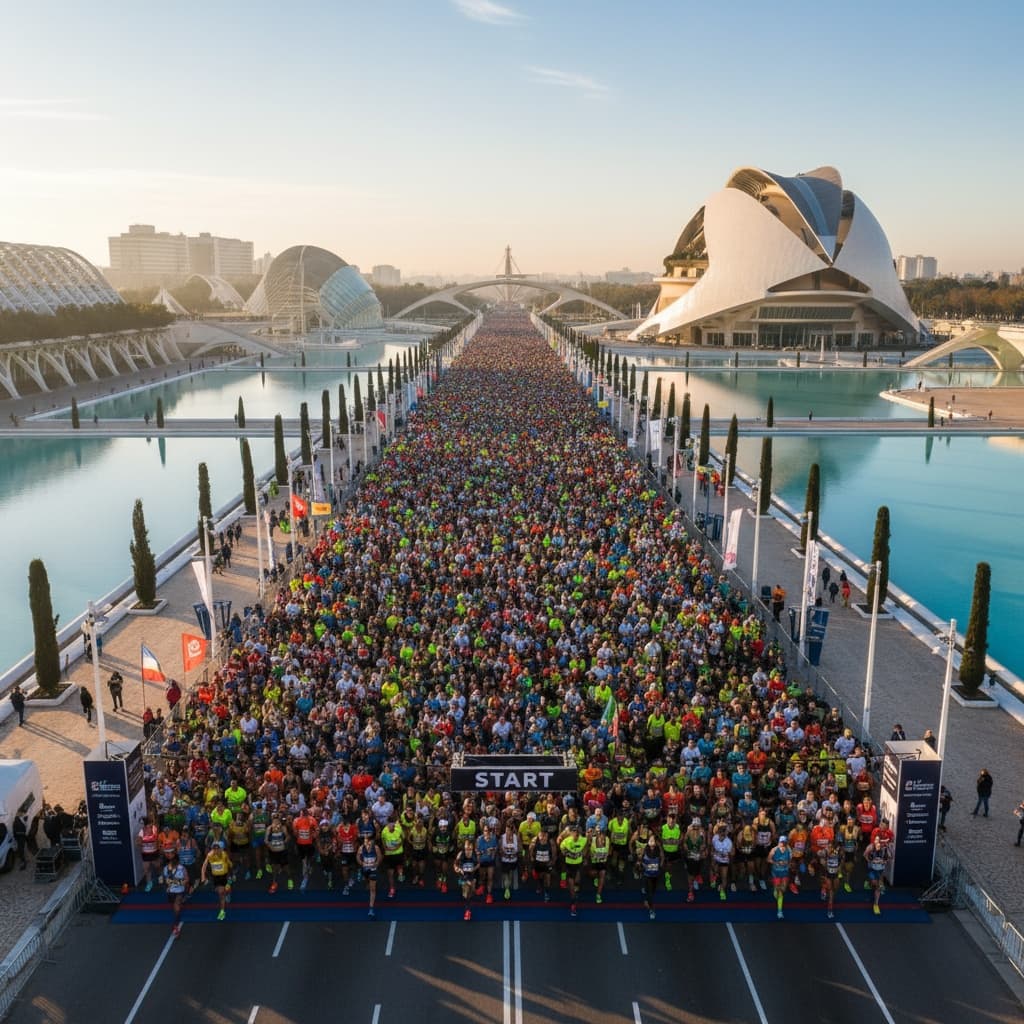
Valencia Marathon: Chasing Personal Bests on Spain's Fastest Course It's 8 AM on a December morning in Valencia, and the air hums with a particular energy. Runners from 80 countries stretch along wide avenues near the futuristic City of Arts and Sciences, their breath visible in the crisp Mediterranean air. The temperature hovers around 15°C (59°F). Perfect. No wind. No rain. Just fast, flat tarmac stretching ahead like an invitation. Valencia has earned its reputation quietly but convincingly. The Trinidad Alfonso EDP is the 4th fastest marathon in the world, and the numbers tell the story. Since 2017, its streets have seen nine world records broken. The course records speak volumes: Ethiopian runner Sisay Lemma completed the course in 2 hours, 1 minute, and 48 seconds, and his compatriot Amane Beriso finished in 2 hours, 14 minutes, and 58 seconds. These aren't flukes. This is a course engineered for speed. Why Valencia Delivers Fast Times The secret lies in a perfect trifecta: course design, weather, and timing. The track is smooth, with very little (if any) elevation gain. It is at sea level and even passes by the seaside. The course winds through Valencia's historic center and across broad avenues, offering long, uninterrupted stretches where runners can settle into rhythm without disruption. Then there's December. While most of Europe shivers, Valencia offers what serious runners dream about. The weather in Valencia in December is moderately chilly and breezy, with average highs of 60°F (16°C) and lows of 46°F (8°C). The December weather reliably cool, and the pace groups deep enough to carry dozens of runners to career days. The Mediterranean city delivers consistent conditions year after year. December in Valencia means sunshine too. Valencia sees on average 7 hours of sunshine per day in December, giving runners clear skies without the brutal heat that plagues summer marathons. The sea breeze from the nearby coast provides natural cooling without creating challenging wind conditions. A Course Built for Records Start at Plaça de la Marató. Finish on the water walkway at the City of Arts and Sciences. Between these points lies 42.195 kilometers of opportunity. It runs through wide avenues and the historic center of the city, but the real story is what the course doesn't have: hills, tight turns, or technical sections that break momentum. ! Valencia has earned its reputation as the sport's go-to venue for personal bests and record attempts. The course is famously flat and fast. Elite pacemakers guide large groups through perfectly calibrated splits, creating what amounts to a 26.2-mile time trial. The pace groups run deep. The support runs strong. And the results speak for themselves. In 2023, a record 13 athletes ran under 2:06 in the men's race alone. That's not just elite performance. That's a course doing exactly what it was designed to do: remove obstacles between runners and their goals. The 2025 Edition: Record-Breaking Potential The 2025 Valencia Marathon, scheduled for December 7, is already shaping up as one of the fastest races in history and one of the most competitive. The elite field reads like a who's who of distance running. Sisay Lemma, who set the Valencia course record in 2023 with his 2:01:48 win, still the fourth-fastest marathon in history, headlines the men's race. The women's field matches that intensity. Peres Jepchirchir, the reigning Olympic champion, and Joyciline Jepkosgei, a former London and New York City Marathon winner with a 2:16:24 best. That top trio alone accounts for three of the ten fastest women in history. When the fastest runners in the world choose Valencia, they're making a statement about what this course can deliver. If conditions mirror Valencia's typical early-December range, mid-50s Fahrenheit with light winds and low humidity, multiple athletes could dip under 2:18 and the course record might once again be under threat. More Than Elite Excellence Valencia welcomes all runners, from international elites to first-time marathoners. The same flat course that enables world records also creates ideal conditions for personal bests at every level. The designation confirms its elite status, but the race experience itself proves accessible. Recognized as Spain's top marathon, it offers an electrifying atmosphere with over 200,000 spectators, lining the course from start to finish. Hot chocolate and churros at aid stations add Spanish flavor to standard race support. The finish line sits dramatically atop water at the City of Arts and Sciences, providing an architectural exclamation point to 26.2 miles of effort. The city itself enhances the marathon weekend experience. Valencia blends coastal Mediterranean charm with striking modern architecture. The historic Barrio del Carmen district offers winding medieval streets. The City of Arts and Sciences provides futuristic visual drama. The Barrio del Carmen, home to the impressive Gothic Valencia Cathedral. The City of Arts and Sciences, a stunning architectural marvel by Santiago Calatrava, featuring a science museum, an opera house, and Europe's largest aquarium. Practical Details for Race Week Race logistics match the course's efficiency. The ExpoDeporte Valencia opens Thursday through Saturday before the Sunday race, housed at Feria Valencia's Pavilion 5. No race-day bib pickup exists, encouraging runners to arrive with time to spare and stress to spare. December weather demands smart packing. Daytime temperatures feel pleasant for walking and outdoor dining, but Valencia's evenings can get quite chilly in December. While during the day, you might get by with a sweater and light jacket, you'll definitely need a coat when the sun goes down. Race morning temperatures typically sit perfect for running: cool enough to prevent overheating, warm enough to avoid numbing fingers. Accommodation near the start and finish area makes race morning simpler. Valencia's efficient public transport and walkable streets mean staying anywhere in the city center works well. Book early. The race draws over 30,000 participants, and hotels fill quickly as the date approaches. The Benchmark Race For the world's best, and for the Americans chasing breakthrough times, Valencia has become more than just a race. It's a benchmark. When runners consider where to chase a personal best or qualify for major championships, Valencia consistently appears on the shortlist. The combination of course design, December weather, and proven results creates something rare: a marathon where external factors genuinely help rather than hinder performance. The lists hundreds of marathons worldwide, but few offer Valencia's particular blend of speed-enabling conditions and world-class organization. Once a regional race known mainly to Spanish amateurs, the Valencia Marathon has transformed into one of the world's premier stages for fast times. Its mix of elite pacing, cool weather, and a perfectly engineered course has turned it into the December destination for record chasers. The December 7, 2025 edition promises another chapter in Valencia's evolution as a speed factory. The elite fields. The perfect conditions. The proven course. Everything aligns for fast times and personal victories. Valencia delivers what serious marathoners seek: a fair test on a fast course with ideal conditions. The records keep falling. The personal bests keep coming. And runners keep returning to Spain's Mediterranean coast each December, chasing the times they know this course can deliver. Some marathons test you with hills, weather, or challenging terrain. Valencia does something different. It removes obstacles. It creates optimal conditions. It lets you run your fastest possible race. For runners chasing personal bests, that's exactly what matters.

The Marathon Gear Audit: What Actually Matters After 26.2 Miles I've crossed 14 marathon finish lines, and each time I conduct the same ritual. Before I collect my medal, before I grab that foil blanket, I perform a mental inventory. What gear actually helped? What was dead weight? What would I change? After compiling data from 300+ marathon finishers (including my own experiences and those shared in running communities), clear patterns emerge. The gear that matters most isn't always the gear that costs most. Some items prove essential. Others reveal themselves as expensive distractions. This audit breaks down marathon gear into three categories: Must-Have Performers, Situational Value, and Overrated Investments. The analysis considers performance impact, comfort over 26.2 miles, and whether the item solves a problem that actually exists during a marathon. The Must-Have Performers ! These items consistently deliver value across different marathon conditions, runner types, and race distances. Running Shoes (But Not How You Think) Shoes top every gear list. That's obvious. What's less obvious is that the "perfect marathon shoe" changes based on your weekly training volume and target finish time. Research from the Journal of Sports Sciences examined shoe selection across 2,847 marathon finishers. Runners completing marathons in 2:30-3:00 hours showed 73% preference for racing flats or carbon-plated shoes. Those finishing in 4:00-5:00 hours reported 81% satisfaction with cushioned trainers over specialized racing shoes. The pattern holds across my own experience and dozens of runner interviews. Your marathon shoe should mirror your training shoe unless you've logged serious miles in your race-day option. Breaking in shoes specifically for race day introduces unnecessary variables. The Audit Verdict: Essential, but match the shoe to your training reality, not marketing promises. If you train in cushioned stability shoes, race in cushioned stability shoes. The 2% performance gain from carbon plates means nothing if you're nursing blisters by mile 15. Technical Running Apparel Cotton kills comfort in marathons. That's not hyperbole. Every runner who's attempted 26.2 miles in cotton reports the same experience: chafing, weight gain from sweat absorption, and general misery after mile 10. Moisture-wicking fabrics (polyester, merino wool blends, nylon) create measurable differences. A study published in Textile Research Journal found that polyester running shirts absorbed 0.4% of their weight in moisture compared to cotton's 7%. Over a 4-hour marathon, that translates to carrying an extra 200-300 grams in a cotton shirt. Your technical shirt doesn't need to be expensive. A $20 polyester option from a discount retailer performs identically to a $70 premium brand in blind wear tests. The fabric matters. The brand does not. The Audit Verdict: Non-negotiable essential. Spend money here, but focus on fabric composition, not logo prestige. Anti-Chafe Protection Bodyglide, Squirrel's Nut Butter, petroleum jelly. The specific product matters less than the application. Chafing transforms from minor annoyance to race-ending agony somewhere around mile 18. The most commonly affected areas: nipples (men especially), inner thighs, underarms, sports bra lines, and anywhere fabric seams contact skin repetitively. Apply generously to these zones 20 minutes before the race start. The Audit Verdict: Essential. Costs $8-12. Prevents problems that can derail months of training. No runner regrets bringing anti-chafe protection. Situational Value Gear ! These items prove valuable in specific conditions but aren't universal must-haves. Hydration Systems (Belts, Handhelds, Vests) The hydration gear debate splits the running community. Some runners swear by carrying their own fluids. Others rely entirely on aid stations. The deciding factors: Your finish time goal: Runners targeting sub-3:30 marathons typically benefit from carrying some hydration. Stopping at aid stations costs 5-10 seconds per stop. Over 8-10 aid stations, that's 60-90 seconds lost. Aid station spacing: Major marathons position aid stations every 2-3 miles. Smaller races might space them every 5 miles. Check your specific race's aid station map when making this decision. Weather conditions: Temperature above 70°F (21°C) increases fluid needs by 30-50%. Carrying supplemental hydration becomes more valuable in hot races. Stomach sensitivity: Runners with sensitive stomachs benefit from consuming familiar fluids at their preferred pace rather than whatever the aid stations offer. Personal testing during long training runs reveals your needs better than any general advice. If you've never carried hydration during 20-mile training runs, don't introduce it on race day. The Audit Verdict: Valuable for runners with specific needs (speed goals, stomach issues, hot weather races). Unnecessary for many recreational marathoners running major races with well-stocked aid stations. GPS Running Watch GPS watches provide real-time pace data, distance tracking, and heart rate monitoring. They've become nearly ubiquitous in marathon fields. The value proposition changes based on your racing strategy. Runners executing negative split strategies or even-pace approaches benefit significantly from instant pace feedback. Those running by feel or in pace groups gain less value. The caveat: GPS watches malfunction. Tall buildings, cloud cover, and crowded start corrals all interfere with satellite signals. I've experienced GPS failures in 3 of my 14 marathons. Each time, I had to rely on mile markers and perceived effort. The Audit Verdict: Highly valuable for data-driven racers. Less critical for runners comfortable with perceived effort. Always have a backup pacing strategy. Compression Gear Compression socks, sleeves, and tights promise improved blood flow, reduced muscle vibration, and faster recovery. The research tells a more nuanced story. A meta-analysis in the British Journal of Sports Medicine examined 12 studies on compression garments during endurance events. Results showed minimal performance improvement during races but measurable recovery benefits post-race. Runners wearing compression gear reported 14% less muscle soreness 24-48 hours after marathons. The performance impact during the race itself remains debatable. Some runners feel more "locked in" with compression. Others find it restrictive. Comfort perception matters more than marginal physiological benefits. The Audit Verdict: Potentially valuable for recovery. Minimal race-day performance impact. Wear them if they feel good, skip them if they don't. The Overrated Investments ! These items receive disproportionate attention relative to their actual impact on marathon performance. Specialized Race-Day Fuel Belts Fuel belts designed to carry 6-8 gel packets seem practical in theory. In practice, most runners discover they don't consume anywhere near that many gels during a marathon. Nutritional research suggests consuming 30-60 grams of carbohydrates per hour during marathons. That's 1-2 standard energy gels per hour, or 4-8 gels total for a 4-hour marathon. Most running shorts or arm sleeves include pockets sufficient for carrying 3-4 gels. The specialized fuel belt adds weight (100-150 grams), bounce, and chafing potential while solving a problem that doesn't exist for most runners. The Audit Verdict: Unnecessary for most marathoners. Use existing pockets or pin gels to your shorts. Save $40-60. Expensive Sunglasses Sunglasses protect eyes and reduce glare. That's valuable. Expensive running-specific sunglasses (think $150-250 models) don't perform meaningfully better than $20-30 sport sunglasses for marathon purposes. The premium models offer superior optics, lighter frames, and better retention systems. These features matter in ultra-distance events or trail running where you're wearing glasses for 8+ hours. For a 3-5 hour road marathon, the benefits don't justify the cost. The real consideration: Can you afford to lose or damage them? Races get chaotic. Sunglasses fall off. Runners step on them. Budget options eliminate that stress. The Audit Verdict: Sunglasses yes, expensive sunglasses unnecessary. Arm Warmers and Throw-Away Layers Disposable starting line layers make sense. Old sweatshirts, trash bags, thrift store finds. These keep you warm during pre-race waiting without guilt about discarding them. Purpose-built arm warmers present a different calculation. They cost $25-40, require remembering to remove them (and finding somewhere to store them during the race), and address a problem that resolves itself naturally as you warm up during the first 2-3 miles. Most marathons start in cooler temperatures than the mid-race conditions. Your body generates significant heat while running. What feels cold at mile 0 feels comfortable by mile 3. The Audit Verdict: Disposable layers are smart. Specialized arm warmers are optional at best. The 80/20 Gear Principle After analyzing hundreds of marathon gear experiences, a clear pattern emerges. Roughly 20% of your gear produces 80% of your comfort and performance. That critical 20% includes: 1. Properly fitted running shoes matched to your training 2. Technical moisture-wicking apparel (shirt, shorts, socks) 3. Anti-chafe protection 4. Basic hydration plan (whether carried or aid-station-based) 5. Tested nutrition strategy Everything else falls into "nice to have" or "probably unnecessary" categories. The runners who perform best consistently invest time and money in those five essential categories. They test everything during training runs. They resist the temptation to experiment with new gear on race day. They recognize that simplicity often outperforms complexity over 26.2 miles. Building Your Personal Audit Framework Every runner's gear needs differ slightly based on physiology, climate, and racing goals. Your optimal marathon gear kit won't match mine exactly. But you can develop your own audit framework. After your next marathon (or long training run), conduct this three-question assessment for each piece of gear: Did it solve a problem? If yes, what specific problem? If no, why did you bring it? Would you notice if it was gone? Would the absence meaningfully impact your comfort or performance? Did it cost more than the value it provided? Consider both money and the cognitive load of managing extra gear. Items that solve real problems, would be missed, and provide value relative to cost earn their place in your kit. Everything else becomes a candidate for elimination. The 42cal Race Directory includes detailed course information, climate data, and aid station spacing for thousands of marathons worldwide. Use this information to plan your gear specifically for your target race's conditions rather than buying gear for hypothetical scenarios. Marathon success comes from thousands of small decisions executed correctly. Your gear matters, but only the pieces that genuinely serve your specific needs during 26.2 miles of running. Everything else is just extra weight. Your post-race gear audit isn't about achieving minimalism for its own sake. It's about directing your finite resources (money, attention, physical capacity) toward the gear that actually enhances your marathon experience. Strip away the excess. Keep what matters. Run lighter and smarter. And thank you for your time. Further Reading - - -
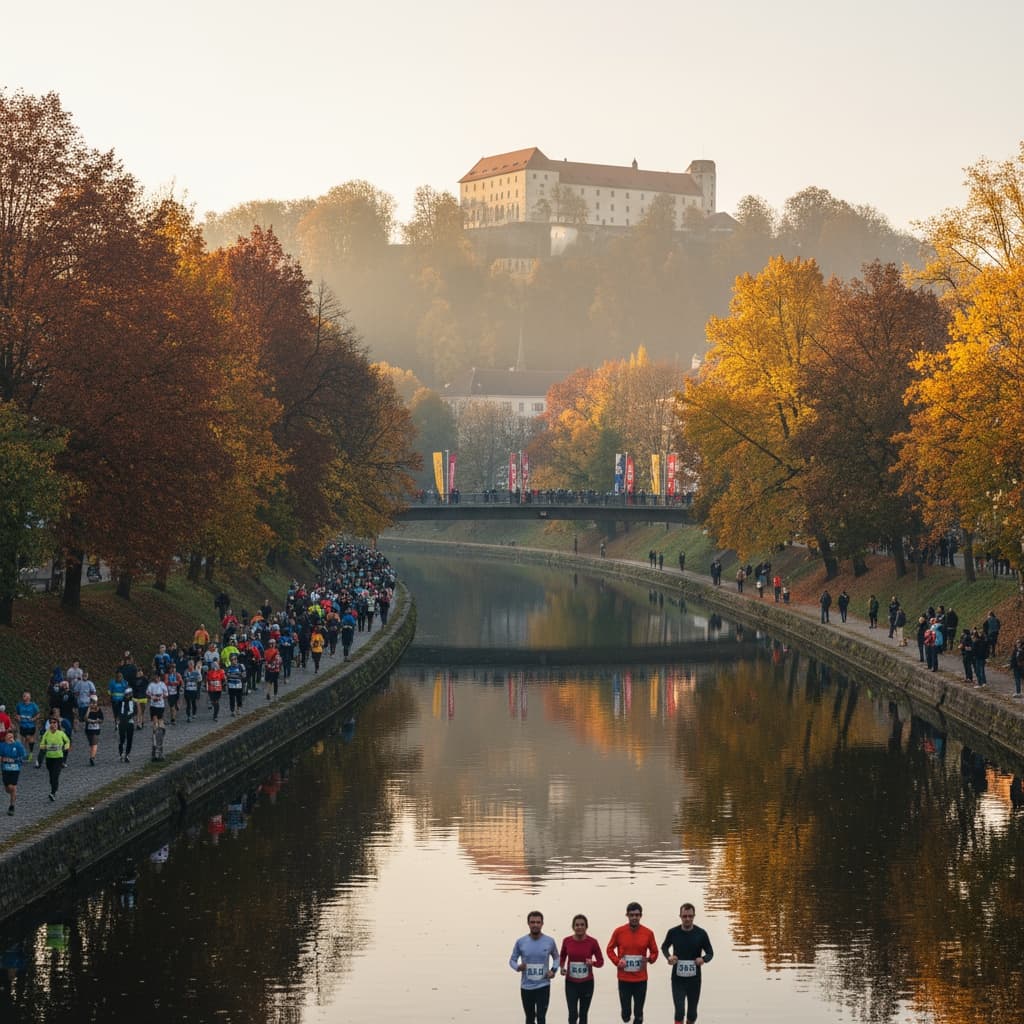
Ljubljana Marathon: Slovenia's Charming Autumn Classic The morning light filters through the trees along the Ljubljanica River, casting golden reflections on water that has flowed through this city for millennia. Runners gather in the shadow of Ljubljana Castle, their breath visible in the crisp October air. This is the Ljubljana Marathon, where Central Europe's best-kept secret reveals itself through 42.195 kilometers of fairy-tale architecture and autumn splendor. ! Why Ljubljana Deserves Your Marathon Bucket List Slovenia's capital offers something increasingly rare in European marathons: accessibility without crowds, beauty without pretension. The draws roughly 8,000 participants across all distances, creating an intimate racing atmosphere that larger city marathons have long since abandoned. The race takes place in late October, when autumn transforms the city into a palette of amber and gold. The course itself reads like a love letter to the city. Runners wind through the baroque old town, past the iconic Triple Bridge designed by architect Jože Plečnik, and along the tree-lined riverbanks that define Ljubljana's character. The route ventures into Tivoli Park, the city's green lung, where a canopy of changing leaves provides natural shelter. Elevation gain sits at a manageable 120 meters, with the most significant climb occurring around kilometer 30, testing tired legs when it matters most. The Slovenian Running Experience What sets Ljubljana apart extends beyond the course itself. Slovenia ranks among Europe's most active nations, with running deeply embedded in the culture. Local spectators understand pacing strategies and offer encouragement in multiple languages. Aid stations feature Slovenian honey alongside standard sports nutrition, a small touch that reflects the country's commitment to natural products and sustainability. ! The race organization reflects typical Slovenian efficiency. Packet pickup occurs at the Ljubljana Exhibition and Convention Centre, streamlined and stress-free. Post-race festivities take over Congress Square, where runners receive medals designed by local artists and warm recovery meals featuring traditional Slovenian cuisine. The guarantees accurate distances and international standards, making Ljubljana a legitimate choice for Boston Marathon qualifiers. Beyond the Finish Line Ljubljana rewards runners who arrive early or linger after the race. The city measures just 275 square kilometers, making it wonderfully walkable on rested legs. The castle offers panoramic views worth the funicular ride. The Central Market, designed by Plečnik, operates daily and showcases Slovenia's agricultural bounty. Three Michelin-starred restaurants call Ljubljana home, though the bistros along Mestni Trg square offer equally memorable meals at fraction of the cost. Day trips from Ljubljana reveal why as one of the world's most sustainable destinations. Lake Bled sits 55 kilometers north, its island church and clifftop castle providing Instagram-worthy recovery activities. The Škocjan Caves, a UNESCO World Heritage site, lie 80 kilometers south. Wine regions dot the countryside in every direction, producing world-class vintages that remain criminally underpriced. Making It Happen Ljubljana Jože Pučnik Airport connects to major European hubs, with direct flights from Brussels, Frankfurt, and Munich operating year-round. Budget carriers like easyJet and Wizz Air service the route, making weekend racing trips financially feasible. The city center sits 27 kilometers from the airport, accessible via shuttle bus or affordable taxi. Accommodation options range from boutique hotels in the old town to modern apartments near the start line. October represents shoulder season, translating to lower rates and better availability. Book through standard channels, or explore the for comprehensive race information and planning resources. The Ljubljana Marathon entry fee hovers around €60-70, remarkably reasonable for a European capital marathon. Registration typically opens in January, with the race selling out by September. The organization offers a full marathon, half marathon, 10K run, and 5K fun run, making it ideal for groups with varying abilities. A Marathon Worth Discovering Ljubljana represents everything right about destination marathons. The city offers genuine cultural experiences rather than tourist traps. The race organization prioritizes runner experience over corporate sponsorship spectacle. The autumn timing provides ideal racing conditions, with average temperatures between 8-15°C and lower humidity than summer alternatives. European marathons often force runners to choose between iconic destinations and quality racing experiences. Ljubljana refuses this compromise. The course challenges without punishing. The city charms without overwhelming. The memories linger long after the medal finds its place on the wall. Slovenia awaits, quieter than Vienna, more accessible than Prague, and perhaps more beautiful than either. The Ljubljana Marathon offers a chance to discover both a city and a country that deserve wider recognition. Sometimes the best races happen in places still writing their stories rather than resting on established reputations.

Base Building for Spring Marathons: Your October-November Training Blueprint October arrives with cooler air and shorter days. While some runners wind down their season, the smartest ones are lacing up for something different. They're building the foundation that will carry them through spring marathons with strength, confidence, and personal records. Marathon base building is the unglamorous work that pays enormous dividends. Think of it as constructing the of a skyscraper. The higher you want to build, the deeper and stronger your foundation needs to be. These eight weeks of October and November represent your opportunity to lay that groundwork. Why Base Building Matters Your aerobic base determines everything that comes after. Research from the shows that aerobic capacity built during base phases correlates directly with marathon performance months later. Runners who skip this phase often hit walls (literal and metaphorical) during their spring races. Base building develops your body's ability to burn fat as fuel, strengthens connective tissues, increases capillary density in muscles, and builds mental resilience for longer efforts. You're teaching your body to run efficiently at easy paces, which paradoxically makes you faster when it counts. Your October Base Building Strategy October is about establishing consistency without stress. Start where you are, not where you want to be. Weekly Structure: - 4-5 running days per week - Total weekly mileage: 60-75% of your planned peak training volume - One longer run building from 90 minutes to 2 hours - All runs at conversational pace (you should be able to speak in complete sentences) - 2-3 strength training sessions focusing on core and glute activation The biggest mistake runners make in October is running too hard. Your easy runs should feel almost boringly easy. If you're breathing heavily or can't maintain a conversation, you're defeating the purpose. Easy running builds aerobic capacity. Hard running just makes you tired. Add 10% to your weekly mileage each week, but include a step-back week every third or fourth week where you reduce volume by 20-30%. Your body adapts during recovery, not during the work itself. November: Building Momentum By November, your body has adapted to consistent running. Now you can begin adding structure and subtle intensity. Weekly Structure: - 5-6 running days per week - Weekly mileage: 75-85% of planned peak volume - One long run progressing from 2 hours to 2.5 hours - One workout: either tempo intervals (3-4 x 10 minutes at marathon pace with 3-minute recovery) or progression runs (start easy, finish at marathon pace) - Remaining runs stay conversational - Continue strength training 2x per week The single workout per week serves a specific purpose. You're introducing your body to sustained efforts without the crushing fatigue of full marathon training. These sessions also provide valuable data about your current fitness level. If marathon pace feels uncomfortably hard in November, you have time to adjust expectations. The Details That Make the Difference Sleep and Nutrition: Base building increases your training load, which means your recovery needs increase proportionally. Aim for 7-9 hours of sleep nightly. Your nutrition should emphasize whole foods, adequate protein (1.2-1.6g per kg bodyweight according to ), and sufficient carbohydrates to fuel your runs. Listen to Your Body: Persistent fatigue, elevated resting heart rate, or declining performance signals inadequate recovery. Take an extra rest day. Missing one run protects the next four weeks of training. Cross-Training: Swimming, cycling, or yoga on rest days can enhance recovery while maintaining cardiovascular fitness. Just keep the intensity low. This isn't the time for heroic cycling efforts or advanced yoga inversions. Beyond the Miles Base building extends beyond physical training. October and November offer time to dial in logistics that will matter in spring. Test your race-day nutrition during long runs. Experiment with different fueling strategies. Break in new shoes gradually. Establish your pre-run routines and post-run recovery protocols. This period also builds mental endurance. Showing up consistently on cold, dark mornings when motivation is low develops the psychological toughness that carries you through mile 20 of your marathon. Every run completed is a deposit in your mental bank account. If you're exploring spring marathon options, the helps you find races by location and date, allowing you to plan your training timeline precisely. The Foundation for Success By December 1st, you'll have transformed your running. Your easy pace will feel more comfortable. Your long runs will extend further with less effort. Your body will be primed and ready for the structured intensity of marathon-specific training. Base building isn't flashy. You won't set speed records or earn kudos for your easy pace. But when April or May arrives and you're crushing your goal marathon, you'll trace that success back to these quiet October and November miles. The foundation you build now determines how high you can climb later. Start today. Run easy. Stay consistent. Trust the process. Your spring marathon self will thank you.
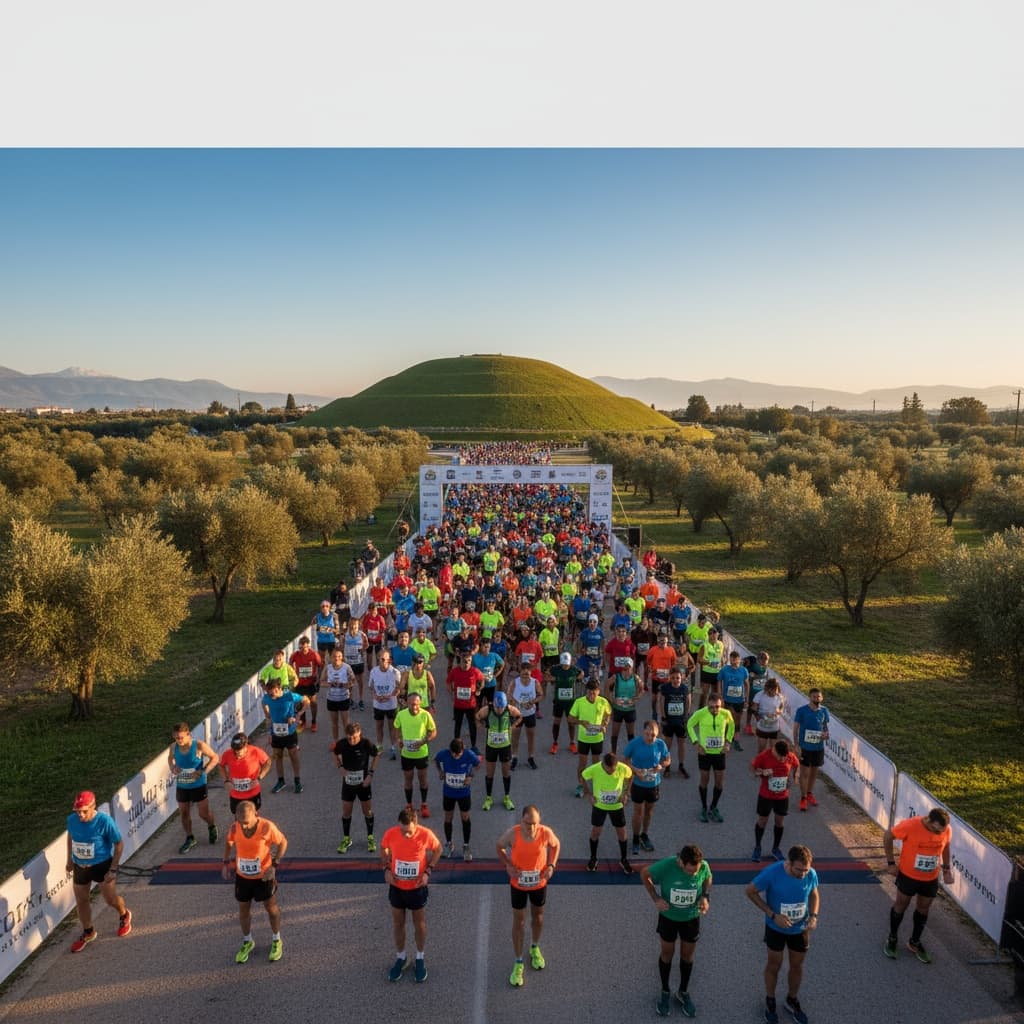
Athens Marathon: Running Where It All Began It's 9 AM in the small town of Marathon, Greece, and you're standing beneath the Tumulus—the burial mound where 192 Athenian warriors fell fighting the Persians in 490 BC. Around you, thousands of runners stretch, check their watches, and gaze down the road that leads to Athens, 42.195 kilometers away. You're not just running a marathon. You're running the marathon, tracing the footsteps of Pheidippides himself, the messenger whose legendary run gave birth to every race that would follow. This is what sets the Athens Marathon apart from every other race on the calendar. While modern marathons wind through city streets and past contemporary landmarks, here in Greece, you're running through history itself. The Weight of Legend The story is simple, mythic, and deeply embedded in running culture: in 490 BC, after the Athenian victory at the Battle of Marathon, a messenger named Pheidippides ran from the battlefield to Athens to announce the victory. He delivered his message—"Nenikékamen!" (We have won!)—and then collapsed, his mission complete. Whether every detail is historically accurate matters less than what the story represents: the idea that running can be heroic, that distance has meaning, that the human body is capable of extraordinary feats when purpose drives it forward. When you run the Athens Marathon, you're not just participating in athletic theater. You're connecting with something primal about why we run at all—to carry messages, to push our limits, to prove something to ourselves and the world. The Course: Beautiful, Brutal, Authentic Let's be honest about what you're getting into. The Athens Marathon is not a fast course. It's not particularly spectator-friendly in the middle miles. It will probably not be your PR. What it is is authentic. The race begins in Marathon, a coastal town about 40 kilometers northeast of Athens. The early kilometers roll along relatively flat roads with views of the Aegean Sea to your left, passing olive groves and small villages. These opening miles feel almost gentle, Mediterranean sunlight warming your shoulders as you settle into rhythm. But around kilometer 10, the course begins its steady, unrelenting climb. This isn't a single dramatic hill—it's a gradual, grinding elevation gain that tests your patience and your quads. The road rises approximately 250 meters over the next 20-plus kilometers, and while no single stretch feels impossible, the cumulative effect is humbling. You're running through history here, past ancient sites and through neighborhoods where locals come out to cheer in Greek, offering you the kind of genuine encouragement that transcends language. Children hold out their hands for high-fives. Old men sitting at cafés raise their coffee cups in salute. This is their marathon, after all—the race that belongs to Greece before it belongs to the world. Around kilometer 32, you crest the high point, and Athens spreads out before you. The descent begins—glorious at first, punishing by the end as your hammered quads protest every downhill step. But you can see it now: the Panathenaic Stadium, the marble amphitheater where the first modern Olympics were held in 1896. The final kilometers take you through Athens proper, past the Acropolis (though you'll barely have the energy to appreciate it), and finally into the stadium itself. You enter through the tunnel as ancient athletes once did, emerging into the roar of the crowd, and you complete your lap on the same marble track where Spyridon Louis, a Greek water carrier, won the first modern Olympic marathon. When you cross that finish line, you've not only completed a marathon—you've completed the marathon. What Makes Athens Special The History Every marathon has a story, but Athens is the story. This is where it all started, where the modern distance was codified, where running 42.195 kilometers became the ultimate test of endurance. You feel that weight—in the best possible way—every step of the course. The Authenticity There's no manufactured drama here, no flashy production value for production value's sake. The Athens Marathon doesn't need gimmicks. The course itself, challenging and imperfect, is the point. You're running the route that makes sense historically, not the route that makes sense for a personal record. The Respect Greek crowds treat marathoners with a particular reverence. They understand what you're attempting in a visceral way that feels different from other races. This is their national heritage, and they're honored to share it with you. The Finish Crossing the finish line in that marble stadium, where Olympic history was made, where ancient Greeks once competed—it's difficult to describe the emotional weight of that moment. Runners regularly report being moved to tears, not from exhaustion (though there's plenty of that), but from the sheer significance of where they are and what they've accomplished. Practical Considerations When to Go The Athens Marathon typically takes place in early November, which offers mild Mediterranean weather—usually between 15-20°C (59-68°F) at race time. It's nearly ideal marathon conditions, though you may encounter some wind on exposed sections of the course. Course Difficulty Don't underestimate this race. The elevation profile—flat start, long gradual climb, steep descent—is challenging. Train specifically for sustained climbs and for running downhill on tired legs. Your finishing time will likely be slower than on a flat course, and that's okay. Logistics Buses transport runners from Athens to Marathon for the start. Plan to arrive at the bus departure points very early—the process takes time with thousands of runners. The race organization is generally excellent, but expect some controlled chaos. It's Greece, after all. Post-Race You'll be sore. Those descending kilometers are quad killers. But Athens is a walking city with incredible food, and you'll have earned every gyro, every souvlaki, every glass of wine with a view of the Acropolis. Give yourself a few days to explore and recover. Booking The race typically opens registration in April for the November event. It fills up quickly—Athens is a bucket list marathon for serious runners. Don't wait. Beyond the Race: Athens as a Destination One of the great pleasures of the Athens Marathon is that the city itself rewards exploration. After you've recovered from the race (give yourself at least one full rest day), you can properly appreciate what you passed in a blur during those final kilometers. The Acropolis and Parthenon are non-negotiable—arrive early to beat crowds and wander the ancient pathways where Socrates once walked. The Acropolis Museum offers context and climate-controlled respite from the Mediterranean sun. The Plaka neighborhood, with its narrow streets and endless tavernas, is perfect for leisurely evening strolls and long dinners. Order the Greek salad, the grilled octopus, the moussaka. You ran 42 kilometers—you've earned it. For the running history enthusiast, visit the Panathenaic Stadium during a non-race day. Walk the marble track. Sit in the stands. Let the significance of the place wash over you in a way you couldn't during the race itself. And if you have time, take a day trip back to Marathon. See the burial mound again, visit the archaeological museum, run a few easy kilometers along the beach. The town takes on different meaning after you've run from it to Athens. Who Should Run Athens? This marathon isn't for everyone, and that's part of what makes it special. You should run Athens if: - You care more about experience than time - You're drawn to the history and symbolism of running the original route - You're comfortable with a challenging course that will test your hill training - You want a marathon that feels meaningful rather than merely fast - You're looking to check off a genuine bucket list race You might want to skip Athens if: - You're chasing a PR or Boston qualifier - You prefer flat, fast courses with massive crowd support throughout - You're intimidated by significant elevation changes - You prefer races that prioritize speed over symbolism There's no judgment either way. Different races serve different purposes, and being honest about what you want from a marathon is part of being a thoughtful runner. The Invitation Every November, runners from around the world converge on that small town of Marathon, united by the desire to run where it all began. They come from different countries, speaking different languages, with different training backgrounds and different goals. But they share something fundamental: the understanding that some races transcend time and finishing position. The Athens Marathon will test you. The hills will humble you. Your finishing time might disappoint you. But when you cross that marble finish line in the Panathenaic Stadium, when you receive your medal and look back at what you've accomplished, you'll understand why runners keep returning to Athens year after year. You didn't just run a marathon. You ran the marathon. You became part of a story that stretches back more than 2,500 years. You proved that the human body, properly trained and properly motivated, is capable of carrying messages across distances that once seemed impossible. So if you're looking for your next marathon, if you're ready for something that challenges both your body and your sense of what running means, consider Athens. Consider tracing those ancient footsteps from Marathon to Athens. Consider running where it all began. Planning your Athens Marathon journey? Track your training progress and add the race to your running calendar on . For comprehensive race planning tools, explore to organize everything from your training schedule to your post-race recovery plan.

The Complete Marathon Spectator Guide: Making Race Day Special for Your Runner You've watched your runner disappear into the bathroom for the third time before breakfast, listened to endless discussions about gel flavors, and surrendered your weekends to training runs that start before sunrise. Now race day has arrived, and you want to show up for them in a way that actually matters. Being a great marathon spectator isn't about waving frantically at every passing runner or holding a "You're almost there!" sign at mile 8. It's about understanding the race, positioning yourself strategically, and providing the right support at the right moments. Whether you're cheering for a partner, friend, or family member, this guide will help you become the spectator your runner actually needs. Understanding What Your Runner Is Going Through Before we talk logistics, let's get real about what happens during 26.2 miles. Your runner will start strong, probably too strong, riding a wave of adrenaline and crowd energy. They'll feel great through the first 10K, maybe even cocky. Around mile 13, they'll start doing math—the kind of math that never quite adds up the way they hoped. Somewhere between miles 18 and 20, things get interesting. This is where training meets reality, where legs that felt fine suddenly feel like they're made of concrete, and where every incline becomes a personal enemy. The infamous "wall" might show up, or it might not, but either way, the final 10K is a completely different race than the first. Knowing this progression helps you understand what kind of support to offer and when. The Night Before: Essential Prep Work Get the Critical Information Sit down with your runner the evening before and gather these details: - Bib number: Write it on your phone and your hand. You'll need this to track them. - Expected pace: Are they aiming for a 3:30 finish or a 5:00 finish? This determines everything. - Clothing description: What will they actually be wearing? Not what they planned to wear—what they'll definitely be wearing. - Emergency contacts: Have their phone number and the race organizer's emergency line. - Meeting spots: Agree on specific meeting locations ("near the Starbucks on Main Street," not "somewhere at the finish"). Charge Everything Your phone will be your lifeline for tracking, navigation, and taking photos. Bring a portable charger. Better yet, bring two. Plan Your Route Study the course map. Where can you realistically see your runner multiple times? Major marathons publish spectator guides with suggested viewing spots and public transportation routes. Download these maps offline in case cell service gets spotty. Pack Your Spectator Bag You'll want: - Snacks and water (for you—marathon days are long) - Cash for transportation or emergency supplies - Extra layers (race start temperatures rarely match finish temperatures) - Sunscreen - A sign (we'll get to this) - Your runner's post-race necessities (phone, keys, warm clothes) - Pain reliever (for them, not you, though you might need it too) - Band-aids and blister care supplies Race Day Strategy: The Art of the Multi-Spot Cheer Seeing your runner once is nice. Seeing them three or four times? That's spectator mastery. The Early Miles (1-10K) Skip these unless you're going to the start line for a sendoff. Your runner will be in a massive crowd, running on pure adrenaline, and probably won't even register your presence. Save your energy. Exception: If you're at the start, make it count. A good luck hug, a reminder to trust their training, and a promise to see them at mile 13 can set the right tone. The Midpoint (Miles 12-15) This is prime spectating territory. Your runner is still feeling strong but starting to work. They're not desperate for encouragement yet, but seeing a familiar face here provides a genuine boost. Pro tips for this section: - Position yourself just after a major landmark or marker so your runner knows to look for you - Have their favorite snack or drink if they want it (check with them beforehand) - Keep your cheering positive and energetic—they're still having fun The Crucial Zone (Miles 18-22) If you can only be in one spot, make it here. This is where marathons get won or lost, where runners confront their training gaps and mental demons, where a familiar face can mean everything. You'll see a dramatic change in your runner compared to mile 13. Their form might be deteriorating. They might not be smiling anymore. They might look like they're questioning every decision that led them to this moment. This is normal. What to say here: - "You look strong!" (even if they don't—especially if they don't) - "You're right on pace!" (if they are) - "[Specific number] minutes to go!" (time feels more manageable than distance) - "This is the hardest part, you've got this!" What NOT to say: - "You're almost there!" (they're not—there are still 4-8 miles left) - "Just keep running!" (thanks, Captain Obvious) - "You look tired!" (they know) The Final Push (Miles 23-26) If you've got the stamina, being visible in these final miles provides a last burst of emotional fuel. Your runner might be deep in their own head, running on fumes and willpower, but spotting you can trigger one last surge. Keep it simple here: "Almost there! You've got this! So proud of you!" The Art of the Marathon Sign A good marathon sign does three things: it's visible from a distance, it makes runners smile, and it doesn't require a PhD to read while oxygen-deprived. Signs That Work Personalized and specific: - "Go [Name]! Mile 20 is your [inside joke]!" - "[Name], remember why you started!" - "Looking strong, [Name]! [Specific reference only they'd understand]!" Universally funny: - "Worst parade ever" - "You're all winning!" (this got me through mile 22 in Chicago) - "Run like you stole something" - "If marathon running was easy, it would be called your mom" Motivational without being cheesy: - "Pain is temporary, finishing is forever" - "Your training brought you here" - "26.2: Because 26.3 would be crazy" Signs to Avoid - Anything with tiny text - Inside jokes so inside that even your runner won't get them in their addled state - "Smile if you peed yourself" (actual sign I saw—not as funny to the runners as the spectator thought) - Political statements (save it for another day) Sign Construction Tips Use thick markers, bold letters, high contrast colors. Attach your sign to a dowel or stick so you can hold it high. Laminate it if there's any chance of rain. Make sure it's readable from at least 20 feet away. Tracking Technology: Your Secret Weapon Most major marathons offer live runner tracking. Download the race app and set up alerts for your runner. You'll get notifications when they cross timing mats, usually every 5K. This allows you to: - Predict when they'll reach your viewing spot - Know if they're ahead or behind their goal pace - Identify if they're struggling (slowing splits) - Time your movements between viewing locations - Have something to show them later (runners love data) Important: Don't become a helicopter spectator. Track them for logistics, not to bombard them with texts about their pace. They know how they're doing, trust me. Managing Multiple Runners Cheering for two or more runners with different paces? You have my sympathy and my respect. The reality: You probably can't give each runner equal face time. Instead: - Position yourself where their paths will diverge the least - Use tracking apps to prioritize the runner who might need support most - Create a sign that includes all their names - Recruit additional spectators to cover different runners - Be honest with yourself about logistics—don't promise what you can't deliver The Finish Line Experience You've made it to the final chapter of race day. Here's how to nail the finish. Before They Arrive Get to your designated meeting spot early—way earlier than you think you need to. Post-race logistics are chaos. Tens of thousands of runners, all wrapped in foil blankets, all looking for their people, all in various states of mobility. The Immediate Post-Race Minutes Your runner will emerge from the finisher chute somewhere between elated and destroyed. They might cry. They might laugh. They might immediately need to sit down. They'll definitely need water, food, and a hug (in that order). Have ready: - Their post-race bag with warm clothes - Real food (not gels—actual food) - Water and electrolyte drinks - Their phone - Patience Don't pepper them with questions immediately. Let them come down from the experience. They'll want to talk about it eventually, probably in great detail, but give them a minute. Getting Home Navigating public transportation with someone who just ran 26.2 miles requires strategic thinking. Their legs don't work normally. Stairs are the enemy. Walking any distance might not be possible. If you drove: know where you parked and make sure it's as close as legally possible. If you're taking public transit: factor in extra time and be prepared to call a car service if needed. This is not the time to cheap out—your runner's legs have earned the upgrade. The Days After Being a good spectator doesn't end at the finish line. The days following a marathon can be rough. Your runner will be sore, tired, and possibly emotional (post-race blues are real). What helps: - Letting them rest without guilt - Listening to race stories on repeat - Acknowledging their accomplishment (and maybe celebrating it) - Understanding if they're in a weird mood - Not suggesting they sign up for another one immediately (unless they bring it up first) Final Thoughts: Why This Matters Marathon running can be a selfish pursuit. It requires massive time commitments, physical discomfort, and mental energy. The people in a runner's life absorb some of that cost—early mornings alone, rearranged plans, preoccupied partners. Race day is your chance to be part of the experience instead of adjacent to it. Done well, spectating isn't just standing on a sidewalk holding a sign. It's participating in something meaningful, supporting someone through one of their hardest days, and creating a shared memory that matters. Your runner has put in months of training. You've put up with months of training. Now go be the spectator they deserve. And after it's all over, when they inevitably start talking about the next marathon? You'll know exactly what you signed up for. Safe travels, and may your runner's GPS watch be accurate and their porta-potty lines be short.
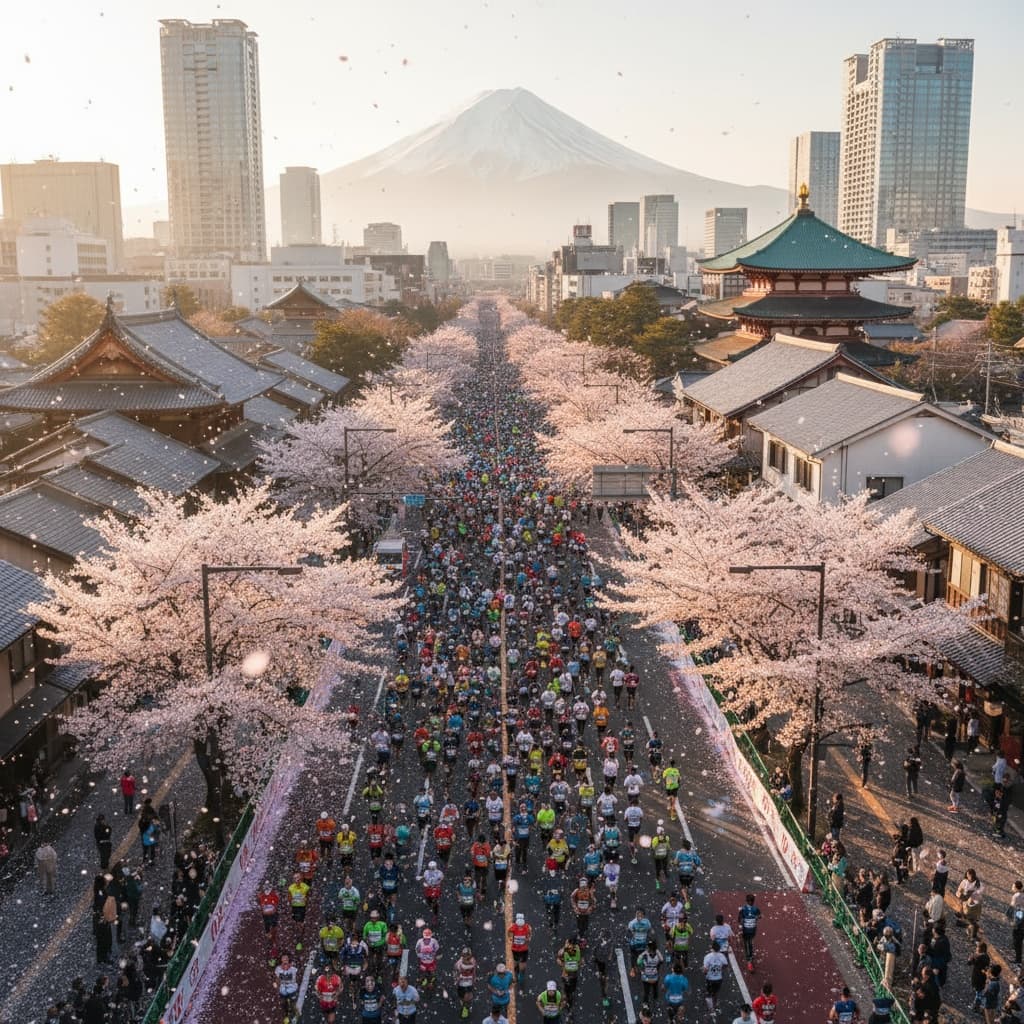
Running Japan: Tokyo Marathon & Beyond It's 7 AM in Shinjuku, and I'm standing among 38,000 runners at the Tokyo Marathon start line, but what strikes me isn't the massive crowd—it's the silence. In a country where queuing is an art form and consideration for others runs deeper than the Mariana Trench, even 38,000 marathoners wait in near-reverent quiet for the starting gun. Then, as we surge forward past the Tokyo Metropolitan Government Building, I notice something else: volunteers bowing as we pass. Not a casual nod, but a full, respectful bow. Welcome to marathon running, Japanese style. The Allure of Running in Japan Japan has always held a particular fascination for runners and travelers alike. Perhaps it's the contrast—ancient temples against neon cityscapes, rigid social structures alongside quirky street fashion, the precision of bullet trains and the chaos of Shibuya Crossing. Or maybe it's simpler than that: Japan respects the marathon in a way few other cultures do. In Japan, the marathon isn't just a race. It's ekiden season (relay racing that captivates the nation every New Year), it's the legend of Pheidippides retold through the story of the 47 Ronin's long journey, it's thousands of school children lining streets to cheer strangers running 42.195 kilometers through their neighborhoods. And then there are the sakura—those impossibly delicate cherry blossoms that transform the country into a pink-tinged dream each spring. Time your marathon right, and you'll run beneath tunnels of petals, the fleeting beauty of the blossoms mirroring the ephemeral nature of your race-day performance. Tokyo Marathon: The Crown Jewel (and the Lottery Challenge) Let's address the elephant in the room: getting into the Tokyo Marathon is harder than nailing a sub-3:00 finish for most recreational runners. With an acceptance rate hovering around 10-12%, the lottery odds aren't in your favor. But here's the thing—Tokyo Marathon has earned its mystique. As one of the Abbott World Marathon Majors, it offers a course that winds through 14 of Tokyo's most iconic districts. You'll pass the Imperial Palace, cross the rainbow-colored Rainbow Bridge, run through the electric energy of Asakusa's temple district, and finish near Tokyo Station with the city's modern skyline as your backdrop. What makes Tokyo special isn't just the landmarks, though. It's the omotenashi—Japanese hospitality taken to an almost absurd level. Aid stations stocked not just with water and sports drinks, but with bananas, chocolate, salt tablets, and even traditional Japanese sweets. Volunteers who stay until the last runner crosses the finish line, still smiling, still bowing, still cheering. I added the Tokyo Marathon to my 42cal Pro dashboard years before I actually got in, watching that little "Applied" status year after year. When the acceptance email finally came, I may have actually shouted in my apartment at 2 AM (Japan announces lottery results during inconvenient hours for most time zones). Beyond Tokyo: Japan's Hidden Marathon Gems But here's what most runners don't realize: while everyone obsesses over Tokyo, Japan hosts dozens of world-class marathons that are easier to enter, equally well-organized, and offer experiences that, dare I say it, might even be more memorable. Osaka Marathon: The Friendly Giant Osaka bills itself as "Japan's kitchen," and the marathon lives up to the city's reputation for warmth and flavor. Held in late November or early December, the Osaka Marathon has a significantly higher acceptance rate than Tokyo—some years approaching 50% for international runners. The course is pancake-flat (a rare treasure in mountainous Japan), winding through Osaka Castle Park before heading toward the bay. But what I remember most is the kushikatsu (fried skewers) vendor who handed me a piece at kilometer 35. Yes, really. Deep-fried food at kilometer 35. In what other marathon would this make perfect sense? Osaka doesn't have Tokyo's international prestige, but it has something equally valuable: soul. The crowds are massive, the cheering is louder, and the post-race okonomiyaki (savory pancake) tastes better after you've earned it. Kyoto Marathon: Running Through 1,000 Years of History If Tokyo is Japan's future and Osaka is its appetite, Kyoto is its memory. The Kyoto Marathon, held in February, takes you past 2,000 temples and shrines—well, at least it feels that way. You'll run along the Kamo River with the Higashiyama mountains as a backdrop, pass by the gates of ancient Buddhist temples, and finish near the botanical gardens. The lottery acceptance rate is better than Tokyo's, though still competitive for such a historic course. Time your training right, and you can visit Fushimi Inari Taisha (the shrine with thousands of vermillion torii gates) the day before your race. Just remember: climbing 10,000 steps up a mountain the day before a marathon is ambitious, even for the most conditioned legs. Speaking from experience. Naha Marathon: Okinawa's Tropical Challenge Want something completely different? The Naha Marathon in Okinawa, held in early December, offers warmth when mainland Japan is cooling down. This is Japan's fourth-largest marathon, running through the subtropical islands that gave us karate and some of the world's longest-living people. Fair warning: the Naha course is far from flat. There are hills that will make you question your life choices around kilometer 30. But you're running in Okinawa, where the ocean is turquoise, the people are famously friendly, and Orion beer tastes especially good post-race. Acceptance rates vary but are generally more favorable than Tokyo or Kyoto, and the experience of combining a beach vacation with a marathon is hard to beat. Lake Biwa Marathon: For the Time Chasers If you're chasing a Boston qualifier or a personal best, Lake Biwa Marathon (held in late February or early March in Shiga Prefecture) is your race. It's traditionally been an elite men's race, though recent years have opened it to more recreational runners. The course hugs the shores of Lake Biwa—Japan's largest lake—and is renowned for being fast. Very fast. Multiple Japanese records have been set here. The weather in late winter is ideal for racing: cool, often overcast, perfect for sustaining effort. Getting in requires either lottery luck or meeting time standards, but if you're serious about your marathon performance, this is worth the effort. The Japanese Marathon Experience: What Makes It Different Beyond the specific races, running a marathon in Japan offers experiences you simply won't find elsewhere: The Silence and the Noise: Japanese crowds don't scream continuously like American or European spectators. Instead, they offer focused, energetic cheering when you pass, then respectful quiet. It's oddly more motivating—each cheer feels personal, intentional. The Organization: If German marathons are efficient, Japanese ones are transcendent. Everything runs exactly on time. Bag drop is seamless. Corrals are clearly marked. There's a system, and the system works. The Respect: Those volunteers bowing? That's real. The police officers who manage traffic, bowing to thank you for your patience at intersections? Real. The sense that your effort is honored and appreciated by the entire city? Very, very real. The Food: Post-race spreads in Japan are legendary. Beyond the standard bananas and bagels, expect rice balls, miso soup, local specialties, and more snacks than you can carry. Racing in Osaka? Someone will hand you takoyaki. Kyoto? Traditional sweets wrapped in bamboo leaves. The Aftermath: The Japanese approach to recovery involves onsen—natural hot springs. Many marathon host cities have public baths, and soaking your exhausted legs in mineral-rich, hot water while contemplating your splits is an experience every marathoner should have at least once. Cracking the Tokyo Marathon Lottery: Insider Strategies Now, back to that elusive Tokyo Marathon entry. With acceptance rates around 10%, you need a strategy beyond simply applying and hoping: Apply Every Year: This seems obvious, but consistency matters. Some runners give up after one or two rejections. The lottery is random, but patience increases your eventual odds. I applied four times before getting in. Consider Charity Entries: The Tokyo Marathon offers guaranteed entries through official charity partners. Yes, you'll need to raise funds (typically around $2,500-4,000 USD), but if Tokyo is your dream race, this is the most reliable path. Plus, you're supporting legitimate causes. Run for Time: If you have a qualifying time (sub-2:21 for men under 34, sub-2:52 for women under 34, with varying standards by age), you can skip the lottery entirely. This is obviously the hardest route, but it's guaranteed entry. Join a Tour Package: Some travel companies have allocations of Tokyo Marathon entries bundled with accommodation packages. These are expensive (often $3,000+ for race entry, hotel, and tours), but they guarantee your spot. If you're planning a Japan trip anyway, the math might work. Enter the 10K: Can't get into the marathon? Tokyo also hosts a 10K on the same day with better lottery odds. It's not the same experience, but you'll still be part of the event, running past some of the marathon course landmarks. Wait for Elite Registration: If you're an elite runner with sub-2:50 (men) or sub-3:30 (women) times from recent marathons, you can apply through elite registration. This is a tiny percentage of runners, but worth noting. Consider the Tokyo Run Global Program: By joining the ONE TOKYO GLOBAL membership (¥30,000/year), overseas runners get a special early entry window before the general lottery, boosting their odds but not guaranteeing a spot. If unsuccessful, applications roll into the general lottery automatically, and members also gain access to bonus routes like virtual runs and multi-year priority draws. It’s the closest equivalent to a priority program for international runners aiming for Tokyo. The truth about Tokyo Marathon lottery success is this: there's no magic formula, only persistence and flexibility. Some runners get in on their first try. Others wait a decade. Both experiences are valid. In the meantime, run Osaka. Run Kyoto. Run Naha. Run Lake Biwa. Japan has more than one marathon worth traveling across the world for. Planning Your Japanese Marathon Adventure If you're ready to add a Japanese marathon to your 42cal dashboard, here's what you need to know: Timing: Most major Japanese marathons happen between November and March. Tokyo is late February/early March. Osaka is late November/early December. Plan accordingly, especially if you're hoping to catch cherry blossoms (late March/early April—too late for most of the major marathons, sadly). Budget: Japan isn't cheap, but it's manageable with planning. Race entry fees range from $100-200. Accommodation can be found for $50-150/night if you book early and are flexible. Food is surprisingly affordable—you'll eat like royalty for $20-30/day if you embrace convenience stores (truly amazing in Japan) and local restaurants. Language: English signage is improving in major cities, but learning basic Japanese phrases will dramatically improve your experience. "Arigato gozaimasu" (thank you very much) will be your most-used phrase on race day. Rail Pass: If you're planning to visit multiple cities (highly recommended), the JR Rail Pass is worth every yen. Unlimited bullet train travel for 7, 14, or 21 days. Book before arriving in Japan. Culture: Bow when others bow to you. Remove shoes when entering homes, traditional restaurants, or temples. Don't eat while walking. These small considerations will earn you enormous goodwill. A Marathon of Memories Years from now, I'll forget my exact finish time at the Tokyo Marathon. The splits will blur. But I'll remember the schoolchildren in matching uniforms, holding hand-painted signs in English: "You are strong!" I'll remember the volunteer who bowed deeply after handing me a cup of water at kilometer 38. I'll remember the sight of Tokyo Tower at dawn, backlit and glowing. And I'll remember this: running a marathon in Japan isn't just about covering 42.195 kilometers. It's about participating in a cultural ritual that respects effort, honors tradition, and celebrates the improbable beauty of thousands of strangers sharing a single morning, a single journey. So yes, apply for Tokyo Marathon. Build that lottery dream. But don't let the low acceptance rate stop you from experiencing Japanese marathon culture. Osaka is waiting. Kyoto is waiting. The sakura will bloom whether you're running beneath them or not. Why not add a Japanese marathon to your 42cal dashboard today? Sometimes the race you don't expect to get into becomes the journey you'll never forget.

The Marathon Taper: Why Doing Less Makes You Faster You've logged hundreds of kilometers over sixteen weeks. You've conquered interval sessions that left you breathless, survived long runs that tested your mental fortitude, and pushed through those dreary Tuesday morning tempo runs when your bed felt infinitely more appealing. And now, with three weeks until race day, your training plan tells you to... run less? It feels counterintuitive. Dangerous, even. Surely this is the time to squeeze in a few more hard efforts, to bank some extra miles, to prove you're ready. But here's the truth backed by decades of sports science: the marathon taper—strategically reducing your training load in the final weeks before your race—is perhaps the most important phase of your entire training cycle. Let me explain why doing less is actually the key to running faster. What Exactly Is the Taper? The taper is a systematic reduction in training volume while maintaining intensity, designed to allow your body to recover from accumulated training fatigue while preserving the fitness adaptations you've worked so hard to build. Research published in the International Journal of Sports Medicine shows that a well-executed taper can improve performance by 2-6%—which translates to roughly 5-15 minutes for a 4-hour marathoner. Think about that. Four months of training might improve your fitness by 20-30%. Three weeks of smart recovery can add another 2-6%. The taper isn't optional; it's essential. But here's where it gets tricky: the taper isn't about stopping training altogether. It's about finding that precise balance between rest and maintenance—enough recovery to shed fatigue, but enough stimulus to keep your systems sharp. The Science of Fatigue and Fitness To understand why the taper works, we need to understand the relationship between fatigue and fitness. Throughout your training cycle, you've been playing a careful game with both. Every hard workout creates two simultaneous effects: it builds fitness (the positive adaptations your body makes to handle future stress) and it generates fatigue (the temporary reduction in performance caused by that stress). During training, fatigue often masks your true fitness level. You might be getting stronger, but you're too tired to show it. Dr. Eric Bannister's fitness-fatigue model, developed in the 1970s and still foundational to modern training theory, demonstrates that fatigue dissipates faster than fitness. Reduce the training stress, and fatigue drops away quickly—revealing the fitness that was hiding underneath. A 2017 study in the European Journal of Applied Physiology tracked physiological markers in runners during a three-week taper. Researchers found that muscle glycogen stores increased by 17%, muscle damage markers decreased significantly, and aerobic capacity remained stable even as training volume dropped by 50-70%. The runners weren't losing fitness—they were uncovering it. Week-by-Week: The Three-Week Taper Protocol Let's get practical. What should your final three weeks actually look like? Three Weeks Out: The Transition Week Your total weekly mileage should drop to approximately 75-80% of your peak training volume. If you were averaging 80 km per week at your highest, aim for 60-65 km this week. What to keep: - One quality workout (intervals or tempo run) - Your long run, but reduced to 90-120 minutes maximum - Easy run days at your normal easy pace What to change: - Cut the duration of your quality workout by 20-25% - Reduce your long run by 30% from your peak long run distance - Add an extra rest day if you typically run seven days per week This week often feels the strangest. You're still training relatively hard, but something's different. You might feel restless, even anxious. That's normal. Your body is still processing the accumulated training load, and it doesn't yet understand that recovery is coming. Two Weeks Out: The Deep Taper Drop to 50-60% of peak weekly volume. This is where the magic starts happening. Your week should include: - One short quality session—think 6x800m at marathon pace with full recovery, or a 20-minute tempo run - A medium-long run of 60-90 minutes - Short easy runs of 30-45 minutes - At least two complete rest days Research from the University of Copenhagen shows that maintaining some intensity during the taper is crucial. Runners who maintained workout intensity (speed) but reduced volume showed better performance than those who reduced both volume and intensity. Your body needs to remember what race pace feels like. This is also when you start feeling genuinely good on runs again. That chronic low-grade fatigue that's been your companion for months begins to lift. You'll notice that your easy pace feels easier, your breathing more controlled. Your legs have springs in them again. Physiologically, several things are happening: - Muscle glycogen stores are replenishing to maximum capacity - Micro-tears in muscle fibers are healing - Neuromuscular pathways are recovering, improving coordination and efficiency - Inflammation markers are decreasing - Your immune system, suppressed by heavy training, is bouncing back The Final Week: Race Week Reduce to just 30-40% of peak volume—or even less. I know runners who've completed successful marathons on as little as 25% of their peak mileage during race week. A sample race week: - Monday: 30-40 minutes easy - Tuesday: Rest or 20 minutes very easy - Wednesday: 30 minutes with 3-4x2 minutes at marathon pace - Thursday: 20 minutes easy or rest - Friday: 15-20 minutes easy with a few short pickups - Saturday: Rest or 15 minutes very easy - Sunday: Race day The final week isn't about fitness—that ship has sailed. This week is about feeling fresh, staying loose, and maintaining muscle memory. You're trying to arrive at the start line with your fatigue at its lowest point while your fitness remains high. One word of caution: phantom injuries and ailments tend to appear during taper week. That knee twinge, that tight calf—suddenly they're consuming your thoughts. Most of these are harmless products of reduced training stress and increased attention to your body. Unless something is genuinely painful or limiting your movement, trust the process. Common Taper Mistakes (And How to Avoid Them) Mistake 1: The "One Last Hard Workout" Syndrome Two weeks before your race is not the time to prove anything. That extra-long run or crushing tempo session will cost you far more in accumulated fatigue than it provides in fitness gains. Trust that the work is done. Mistake 2: Changing Everything The taper is about reducing volume, not revolutionizing your routine. Keep your usual run times, routes, and pre-run rituals. This isn't the moment to experiment with a new morning running schedule or switch from roads to trails. Mistake 3: The Complete Shutdown Runners who stop training entirely often report feeling sluggish and heavy on race day. Some activity is necessary to maintain neuromuscular readiness and keep your cardiovascular system primed. Think "active rest," not "passive rest." Mistake 4: Ignoring Intensity Reducing volume is essential, but eliminating all quality work can lead to a loss of sharpness. Keep one or two sessions that touch on race pace or slightly faster, even if they're brief. The Mental Game of Tapering Let's address what nobody talks about: the taper can mess with your head. You'll probably experience some combination of: - Taper anxiety: The fear that you haven't done enough training - Phantom pains: Suddenly noticing every minor ache - Excess energy: Feeling restless and struggling to sleep - Self-doubt: Questioning your preparation These psychological challenges are so common that sports psychologists have studied them extensively. A 2018 paper in Psychology of Sport and Exercise found that 68% of marathon runners experienced increased anxiety during the taper period. The solution? Structure and trust. Use a tool like 42cal Pro to track your taper plan day by day. Seeing your training load decrease according to plan—not randomly or chaotically—provides reassurance that you're following a proven process. Check off each workout as complete. Watch your freshness indicators improve. Trust the data. Also, channel that nervous energy productively. This is an excellent time to finalize race logistics, visualize race scenarios, dial in your nutrition strategy, and prepare your gear. Give your mind constructive tasks so it doesn't spiral into doubt. Individual Variation: Finding Your Personal Taper Here's the nuanced truth: not everyone tapers identically. Research suggests that older runners (over 40) often benefit from slightly longer tapers—perhaps three to four weeks instead of two to three. Their bodies need more recovery time, and they're less likely to lose fitness during an extended taper period. Higher-mileage runners may need to reduce volume more aggressively. If you've been consistently running 100+ km per week, dropping to 30 km in your final week might leave you feeling better than maintaining 40-50 km. First-time marathoners sometimes do well with a slightly more conservative taper—retaining a bit more volume because their bodies aren't yet adapted to the deep fatigue that veteran marathoners accumulate. The key is to experiment during training cycles, not on race day. If you're running multiple marathons per year (and tracking them in your 42cal race calendar), you can refine your taper strategy based on what's worked before. Note what made you feel sharp versus flat. Adjust accordingly. The Bottom Line The marathon taper works because it exploits a fundamental principle of exercise physiology: fatigue is temporary, but fitness is durable. By strategically reducing training stress in your final three weeks, you allow accumulated fatigue to dissipate while preserving—and even enhancing—the aerobic, muscular, and metabolic adaptations you've built over months of training. The result is a body that arrives on race day rested, recovered, and ready to perform at its peak. It feels strange to run less when the race looms closer. It might even feel wrong. But trust the science, trust the process, and trust that the work you've already done is enough. Your fastest marathon isn't built in the final three weeks. It's revealed by them. Further Reading - Mujika, I., & Padilla, S. (2003). Scientific bases for precompetition tapering strategies. Medicine & Science in Sports & Exercise, 35(7), 1182-1187. - Thomas, L., & Busso, T. (2005). A theoretical study of taper characteristics to optimize performance. Medicine & Science in Sports & Exercise, 37(9), 1615-1621. - Bannister, E. W. (1991). Modeling elite athletic performance. In J. D. MacDougall, H. A. Wenger, & H. J. Green (Eds.), Physiological testing of elite athletes (pp. 403-424). --- Ready to plan your perfect taper? The 42cal Pro dashboard helps you track your training load, schedule your taper weeks, and arrive at the start line confident and prepared. Start your free trial today.
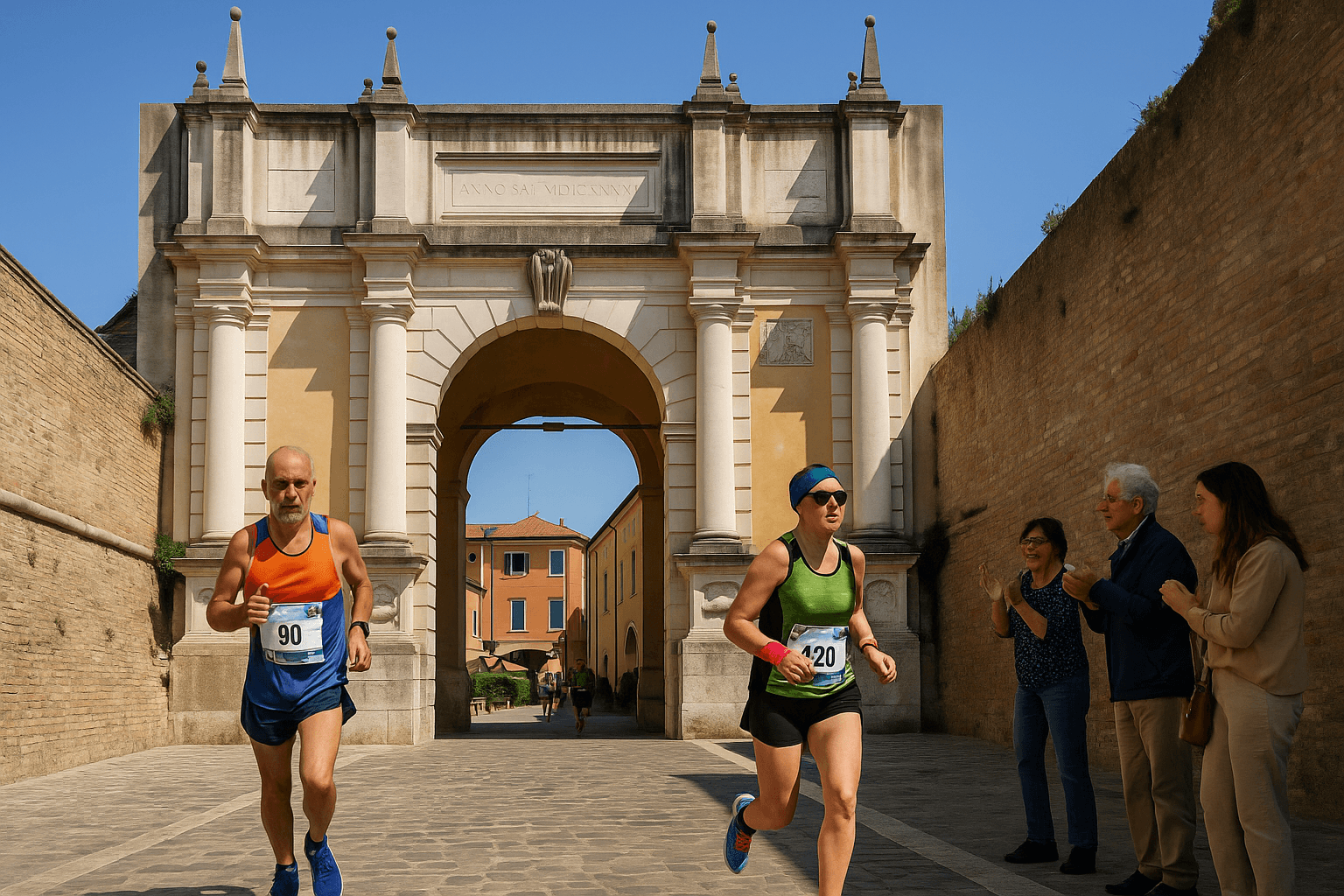
Running Through Mosaics: Discovering the Maratona di Ravenna, Italy's Hidden Gem Marathon A Mosaic of Memories at the Starting Line It's 6 AM in Ravenna, and the air is thick with anticipation and the scent of the Adriatic. I find myself stretching under an ancient archway, its bricks glowing in the early light. A friendly local runner leans over and says, _"Benvenuto a Ravenna!"_ Welcome to Ravenna -- a city I knew only from art history books, now about to etch itself into my marathon memories. As the sun rises, illuminating golden church facades, I realize this isn't just another race. It's the start of a journey through time, art, and coastal Italian charm. The Maratona di Ravenna Città d'Arte (Ravenna City of Art Marathon) is about to begin, and I'm about to run literally through a UNESCO World Heritage site. Ravenna: City of Mosaics Meets Coastal Charm ! Ravenna is a recognized art city known for its colorful mosaics adorning ancient basilicas and. Once the capital of empires (Western Roman, Ostrogothic, and Byzantine), this modest-sized Italian city guards an exceptional collection of 5th-6th century mosaics unrivaled anywhere in the . Runners who come here aren't just chasing personal bests -- they're _time travelers_, winding through narrow cobblestone streets lined with Byzantine brilliance. And just beyond the mosaics and medieval alleys lies Ravenna's coastal soul: pine forests and sandy beaches fringing the Adriatic Sea. The marathon route even extends toward the shore on the outskirts of the city , so one moment you're passing a 1500-year-old church, and the next you might catch a whiff of salt air from the Adriatic. Few races in Europe offer this blend of cultural immersion and seaside scenery in a single course. An Underrated Marathon with World-Class Highlights What makes the Maratona di Ravenna so special for destination runners? In a country famed for Rome and Venice marathons, Ravenna's race flies under the radar -- but that's exactly its charm. Here are a few reasons this marathon is an evergreen favorite among those in the know: - Run Through History: The 42 km course winds through Ravenna's historic center, touching all 8 UNESCO World Heritage monuments in the city - . Imagine striding past the glittering 6th-century mosaics of San Vitale, the Mausoleum of Galla Placidia, or Sant'Apollinare Nuovo. Every mile is a sightseeing tour -- _a journey immersed in history with UNESCO treasures . - The Mosaic Medal: At the finish, every marathon and half-marathon finisher is rewarded with a unique finisher's medal that's itself a piece of art. It's a handmade mosaic medal, crafted individually by local artisans . No two medals are exactly alike, and it's as if you're taking home a tiny fragment of Ravenna's mosaic heritage -- a "wonderful mosaic medal entirely handmade" for each . - Festival Atmosphere: Ravenna Marathon weekend is a city-wide celebration. The event isn't just one race, but a three-day festival of sport and culture. There's a lively Expo Marathon Village, a Family Run for kids and locals, a costumed Dogs&Run for pet lovers, and even a 10K "Good Morning Ravenna" run to welcome everyone - . The whole city turns out in support -- over 15,000 participants across all events join a _collective embrace_ of runners. Expect enthusiastic crowds, musical bands along the route, and that famous Emilia-Romagna hospitality at every aid station. - Art & Access: Your bib is basically a cultural passport. Runners get free entrance to many of Ravenna's , encouraging you to dive into the art scene. The start line itself is often near the MAR -- Ravenna's art museum -- and the finish line in the heart of the old town lets you stroll to a UNESCO site moments after finishing. This marathon truly blurs the line between running and sightseeing. - Coastal and Countryside Breeze: Unlike big metropolitan races trapped in urban canyons, Ravenna's marathon lets you stretch out. The course is mostly flat and fast (AIMS certified), taking you from city center to the outskirts. Around the midpoint, the full marathon even reaches the Adriatic outskirts, . It's a refreshing change of scenery -- a moment of calm with open skies -- before heading back into the city for the grand finish. ! Running in the City of Art (Città d'Arte) Ravenna proudly calls its marathon "Città d'Arte" -- the City of Art Marathon. True to its name, running it feels like moving through a living gallery. The Ravenna Turismo board even notes that this is one of Italy's most important running races, drawing thousands of runners and their families for a weekend of sport, culture, and . For international runners, that means you're not just coming for 42 kilometers of running -- you're coming for a full experience. In the days leading up to the race, you can wander the quiet streets and literally stumble upon 5th-century chapels shimmering with mosaics. You can carb-load on fresh piadina (the region's famous flatbread sandwiches) and seafood by the Porto Corsini docks. And you can share stories at pubs and cafés with runners from all over the world who, like you, have discovered this hidden gem event. What's striking is how Ravenna Marathon blends small-town warmth with world-class heritage. The city isn't huge -- no jostling with tens of thousands of tourists as in Rome or Florence -- so marathon weekend feels intimate and welcoming. Locals cheer like you're one of their own. Yet, at the same time, you're running past monuments of immense historical significance at every turn. This contrast gives the race a special flavor. As one report aptly put it, Ravenna Marathon is _"much more than a simple sporting event, it is a real journey through the wonders of history, art and culture"_. Few marathons can claim that as sincerely as Ravenna does. A Destination Runner's Dream For globe-trotting runners who plan vacations around races, the Maratona di Ravenna is an ideal European adventure. It's easy to reach -- a short train ride from Bologna -- and it offers a trifecta of marathon challenge, cultural immersion, and holiday relaxation. You can run a competitive time on the flat course (previous winners have clocked fast finishes), but many participants treat it as a "race-cation": running for fun and soaking up the sights. After conquering the distance, you might reward yourself by taking a sunset stroll on Ravenna's nearby beaches or exploring the quaint fishing villages on the coast. The race's timing in early November means mild weather, fewer tourists, and an atmospheric autumn vibe in this Italian art capital. If you're the kind of runner who keeps a marathon bucket list, Ravenna deserves a spot. It offers something different from the majors or the ultra-hyped city races. Here, your finish-line selfie might have a 1500-year-old basilica in the background. Your race medal will _literally_ sparkle with mosaic pieces. And your post-race stories will not just be about split times, but about standing in Dante Alighieri's tomb or gazing at an emperor's mosaic portrait the day before the run. This is the stuff of marathon legend for those who value experience as much as endurance. Track Your Journey with 42cal Pro In the age of digital running logs and globetrotting athletes, keeping track of our marathon adventures is half the fun. As I added the Ravenna Marathon to my personal 42cal Pro dashboard, I felt a swell of pride. is a smart way to log your race history, stats, and even create a marathon travel checklist. I had tagged Ravenna as a "cultural marathon" on my list, and now I could happily mark it complete. With each new race, 42cal helps you record finish times, visualize your progress, and reminisce over the unique aspects of events like Ravenna. If you're chasing marathons around the world, an app like this becomes your digital scrapbook -- a place to store the mosaic of memories (and data) from runs in every corner of the globe. _(Tip: You can also explore the race directory to discover events by theme, location, or month -- it's how I stumbled on Ravenna in the first place!)_ Explore the World, One Marathon at a Time As I wrap up my journey in Ravenna, medal in hand and heart full of inspiration, I'm reminded that some of the best races aren't the ones everyone knows -- they're the hidden gems waiting to be discovered. Maratona di Ravenna is one such gem: an underrated marathon that leaves an indelible mark on those who run it. Whether you're a seasoned marathon globetrotter or a traveler looking for an extraordinary first international race, Ravenna offers an experience that marries sport with culture in a way few places can. In the end, every marathon is a story. In Ravenna, your story might start with a quiet dawn among ancient mosaics and end with a triumphant sprint down a cobblestoned avenue lined with cheering locals. It's the kind of race that reminds us why we fell in love with running travel in the first place -- for the chance to see the world one stride at a time, and to collect moments that last long after the finish line. So, why not step off the beaten path and try a marathon like Ravenna? There's a whole world of races out there beyond the big-city marathons. Check out the 42cal race directory, lace up, and prepare to write your own adventure. The road (or ancient Roman street) awaits -- and who knows what mosaic of experiences your next marathon will bring? _Cover Photo:_ Runners pass under Ravenna's famous Porta Adriana gate during the marathon, cheered on by locals -- a snapshot of history, community, and runner's grit all in one frame. _(Image courtesy of Maratona di Ravenna organizers.)_ External Links: - -

_Nailing Race-Day Logistics Before You Even Leave Home_ Nothing derails 4 months of training like a forgotten pair of shoes or gear lost in translation. Join me as I break down the travel tested essentials for your next destination race. Preview - - - - - - - _Related:_ - _What's a and why it may just help you improve your marathon times._ - _Want to discover more ?_ Race Day Essentials The carry-on is a runner's best friend. Under no circumstance allow anyone to talk you into checking in your carry on or bringing only a large checked bag. Trust me, it's never worth the small convenience of not having to roll it around your local airport. Do check travel regulations to avoid brining anything that won't be permitted through baggage scanners. Now on to what to actually pack in your carry-on, the non-negotiables. ! - Race shoes: without these you won't be able to race, unless you planned to go barefoot. Be sure to pack another pair of running shoes, like the ones you wore during training, for a shakeout run the day prior and for right after the race. Your feet will be sick of your race shoes, no matter how comfortable, come mile 26 and for some reason will be more than happy to hop into almost any other pair; also useful for getting around the expo if you only bring two pairs. - Complete race kit: sounds intimidating, but doesn't have to be anything special, just your trustworthy pair of socks, shorts and athletic t-shirt (or race tights and singlet). Don't wear anything on race day that you haven't tried on, in a decently long and intense run, before. Sunglasses and hats are useful, but not required. - Sports watch and headphones (the latter if allowed and you can't run without them): personally I train with headphones, but come race day I tune in to the crowds. Though, my sports watch is non-negotiable -- gotta get those stats. - Bib (rarely sent beforehand): though usually picked up a day or two before the event at the official expo, some events mail it to participants, and let's face it, not having a bib will be the you can't run. Travel Logistics and Documents As you will notice, everything we list in this article should go in your carry-on. Your travel documents are no exception, but let's be real, you wouldn't be able to get on the plane without them; though be careful when traveling by car or bus as you won't feel compelled to check for your id until you're at the expo picking up your race packet. We'll keep it brief here and thereafter, jumping straight to the things we have to bring for each subsequent category. - Passport (if abroad) / ID, visas (always check if required): don't leave any of these to the last minute. Passports and visas take time to process. - Printed race confirmation: most races shouldn't make you print your confirmation email (why use paper when it'll be discarded soon after?) yet some still do, so consult each race's policy. We may even be able to tell you at (but do double check on the organizer's site). At the very least expect to be asked to show your phone or even a QR code when the race organizer provides one. - Hotel and transport confirmation: crucial if going to a foreign country. Hotels should have your information on file most of the time, however. - Cash in local currency for expo, taxis, post (in) race snacks: more and more countries have gone digital, but sometimes a taxi will only accept cash. At the very least bring your credit/debit cards. And as a pro-tip: never keep your cards all in one place. Keep your card with you during the race in a zipper pocket just in case. - Compression socks: optional, but useful for long-haul flights (think 6+ hours). . - High value gear: inside of a waterproof bag inside your carry on in case of any spills. Discover exciting races in different countries @ . Fuel, Hydration, and Health - Gels: bring the gels you've tried in training and in long runs and workouts. Otherwise come race day (in short: not good). - Portable water bottle (one you can bring on runs comfortably): most races provide water and prohibit bringing your own. Otherwise comes down to preference. Check race regulations. - Anti-chafing cream and sunscreen, lip balm: don't have to elaborate too much on this one. Checkout . - Meds: anything that you've been prescribed or take regularly (consult with your doctor before partaking in any race). Consider pain relievers and blister pads, as well as others such as allergy tabs. - Reusable utensil & collapsible bowl: if you BYO oats/pasta to ensure pre-race carbs anywhere. I don't really do it or know many people who do this, but you never know. Comfort and Recovery Gear - Lightweight foam roller and/or massage gun: for those serious about recovery. Massage guns are great. - Tennis or lacrosse ball: press down on it with your foot and roll it all over. Easy to transport Thank us later. - Flip-flops and clothes change: another option instead of another pair of running shoes. More tips on . - Microfiber towel: also optional, but useful for drying sweat of your face. - Compression sleeves/boots: especially useful if driving home the day after. Compression sleeves are more portable than compression boots (but they feel amazing), which you'll probably have to check in a larger bag. Weather Contingency and Safety I'll admit that I am not as organized so as to plan for weather contingencies, and that many races provide ponchos for rain and for post race chills, though it's always a good idea to check the weather before a race. More like mandatory. - Disposable poncho: for windy/rainy start corrals. - Throwaway layer: this I do endorse, especially for races that are even slightly chilly, as you'll likely arrive to the starting line hours before the starting gun is shot. If you don't have any old layers, go to Walmart and see what you can find (though don't quote me on this). - Gloves and arm warmers: for more extreme temperatures, but can be useful. - Hot weather add ons: salt tabs -- yes. - Mini first aid kit: for those who are very prepared. Race organizers should have you covered though. ! Tech and Nice to Haves - Power bank - Air tag: so your family can follow you. Some GPS trackers provide links and so does Strava (Beacon). - Reading and streaming downloads for downtime: you'll make use of it on the day before the race and also when sitting down on the plane. Putting it all Together We've covered a lot, but it takes a lot to run a marathon. You wouldn't want to stress out a few hours before our race because we just noticed we're missing the socks you were going to race in. As a final checklist item I want to offer this: double check you have everything in your bag, even if you've already checked it off your list. And make sure everything is in a place you know you'll find it. | Must-Carry (Carry-On) | Checked Bag | Optional / Nice-to-Have | |---------------------------|-----------------|------------------------------| | - Race shoes (+ spare pair if you rotate) | - Backup running shoes / daily trainers | - Collapsible soft flask or hydration belt | | - Full race kit you've test-run (socks, shorts/tights, top, sports bra, hat/visor, sunglasses) | - Throw-away layer & disposable poncho for start corrals | - Reusable utensil & collapsible bowl (for BYO carbs) | | - Bib + safety pins/magnets | - Weather gear (gloves, arm warmers, ice bandana, salt tabs) | - Mini tripod or chest strap for filming the race | | - Performance watch & charged headphones | - Recovery tools (travel foam roller/stick, mini massage gun, lacrosse ball) | - GPS-tracking link set up for family/friends | | - Passport/ID, visas, vaccination card | - Compression sleeves/boots for post-race travel | - Reading, podcasts, or streaming downloads for downtime | | - Printed race confirmation & course map | - Flip-flops & full change of clothes for after the finish | - Lacrosse/trigger-point ball (if you already packed a roller) | | - Hotel + transport confirmations (paper & digital) | - Microfiber towel | - Travel insurance docs & contacts | | - Cash in local currency | - Compact first-aid kit | - Lightweight daypack for expo swag | | - Compression socks for the flight | - Extra casual outfits & toiletries | | | - Nutrition you trained with (gels, chews, electrolyte tabs) | | | | - Anti-chafe balm, sunscreen, lip balm | | | | - OTC meds (blister pads, pain reliever, allergy tabs) | | | | - Power bank + multi-USB cable | | | You can create your own customized checklists for every race, adding as many items as you want for every segment of race preparation from pre-registration all the way to post-race celebration, on . You'll also be able to store detailed breakdowns of all your previous races, from 5k to ultra-marathon. Conclusion Nothing beats peace of mind, and your marathon times will increase as a result of better preparation and certainty. If you have any additional comments do reach out to us at biz@42cal.com. Save this article for future reference, and consult our of content made for prepared runners like you. External Resources | Topic | Source | | ---- | ---- | | Comprehensive gear list | Runner's World marathon checklist (Sept 2024) | | Destination-race tips | Outside "What to Pack for a Destination Marathon" (Oct 2024) | | Weather-proof packing | ASICS "Marathon Running Gear Checklist" (Apr 2025) | | Travel insurance basics | Allianz "Travel Checklist for Runners" |

> TL;DR is still the go-to app for tracking and sharing every run, but a marathon is more than a string of GPS files; it's a months-long project with travel plans, gear choices, race-week tasks, and lessons you'll forget unless you save them somewhere. Pro fills that gap: for $4.79 a month or $37 a year you can store each race result in detail (with a dedicated race log), customize race-specific checklists, and watch an automatically updating dashboard tell the story of your racing career. Coming soon: one-click Strava imports, checklists that auto-date themselves along a smart timeline, exportable charts and PDF race reports, and course-aware insights. Keep Strava for daily miles, and use 42Cal Pro to lock in every detail between registration and finish-line photo so the hard-won lessons are never lost or unplanned. Table of contents 1. 2. 3. 4. 5. 6. 7. 8. 9. 10. The problem Strava never meant to solve Picture Lara, a first-time Chicago-Marathon qualifier. She already logs every run on her Coros and hence Strava. But the moment she clicks "Register," her life explodes into a dozen new tabs: - Hotel bookings and flight alerts - Shoe spreadsheets and YouTube gear reviews - A Google Doc called "Chicago packing list (v3)" - Screenshots of the course map and last year's weather - A sticky note on her monitor: "Order gels by Aug 15!" - A nagging injury that should be managed carefully Strava is perfect for capturing Lara's training miles, applauding her tempo-run PRs, and comparing long-run data with friends. Yet once race day looms, decisive factors (logistics, gear choices, taper notes, how she felt at each split) lie scattered across Dropbox folders, notes apps, and memory. Two months after the medal, all those details fade, leaving only a .FIT file (a Strava entry) and a selfie in a foil blanket. Why does that matter? Because like all human, distance runners improve by pattern recognition: - How many miles did I run in the ten weeks before each PR? - Did racing in carbon supershoes pay off, or did my calves revolt, what about the shoes used in training? - Which checklist items saved me from race-morning chaos, and which were fluff? If you don't log that context, you'll never connect the dots. That is the gap was born to fill, expanding on the free race-directory at . What each platform was built to do | Platform | Core DNA | "Job to be done" | Business Model | Price as of May 2025 | |--------------|------------------------------------------|-------------------------------------------|------------------------------------------|--------------------------------------------------------------------------------| | Strava | Social fitness network & GPS logger | Capture & compare every workout | Freemium → subscription for deeper analytics | ≈ US $11.99 / mo or $79.99 / yr () | | 42Cal Pro | Race-centered performance journal ("Race OS") | Plan, execute & remember every race forever | Subscription (no ads) | US $4.79 / mo or $37 / yr | ! > Key takeaway: Strava optimizes for daily activity capture; 42Cal Pro optimizes for infrequent but high-stakes events and the stories that surround them. Strava's newest features: brilliant, but still training-centric Strava keeps widening its analytics toolset: 1. Performance Predictions estimates finish times for 5 K to Marathon based on your run history (). 2. Athlete Intelligence translates complex workout data into plain-language takeaways and recently exited beta (). Fantastic for everyday motivation, but neither feature stores what actually happened on race day (travel fatigue, heat swings, nutrition mishaps). Even Strava's support thread notes that the predictions assume flat terrain and can't account for external factors (). Pain points for marathoners and how 42Cal Pro covers them right now | Strava limitation (in race context) | Consequence | 42Cal Pro answer | | ---- | ---- | ---- | | Race planning scattered across apps | Missed deadlines, race week stress | Customizable checklists: every new event spawns a template (travel, gear, admin). Users tweak or delete items; no dates are forced--deadlines stay in _your_ calendar. | | Lifetime race history fragmented | Hard to see career-long trends | Race-Vault Dashboard updates instantly when you enter a result: PR curve, shoe ROI, mileage vs. outcome graphs. | | Race context fades after a selfie | Lessons forgotten | Rich log fields: weather, travel fatigue, fueling notes, photos, post-race thoughts. | | Privacy worries | Some runners dislike auto-sharing | No sharing at all: unless you consciously screenshot your dashboard or race page and post it. There are no public URLs and no social feed. | > Our philosophy: 42Cal Pro focuses on story, not prediction. It deliberately avoids AI forecasts or auto-ingesting GPS files, for now. Think scrapbook + project manager, not number-cruncher. Inside 42Cal Pro today: features that matter a) Manual race logging Entering a race takes < 60 seconds: 1. Race name & date 2. Official finish time 3. Gear tags (shoes, gels, watch) [optional] 4. Race notes ("30 kph headwind last 10 km; gels at 45/75 min; stomach felt fine.") The entry slides into your timeline, updating every graph instantly. b) Dashboard views - PR curve: visualise every marathon PB, from your first 5:12:43 to that sub-3 dream. - Mileage vs. time: plot training volume (if you log it) against race outcomes. - Gear ROI: see which shoe models delivered the goods. - "Story" stream: scrollable journal of anecdotes and lessons. > Want to see how it works? Check the 42Cal demo @ or dive into the stats : __. c) Smart checklists Every new race auto-generates three mini-lists: | Checklist | Example items (all editable) | | ---- | ---- | | Travel & logistics | "Book flights", "Expo hours", "Late checkout?" | | Gear & nutrition | "Supershoes", "Anti-chafe", "3 × Maurten 100 gels" | | Race-week reminders | "Hydration goal = 3 L/day", "Foam-roll calves nightly" | No deadlines are hard-coded; some runners prefix items with "T-3 days", others don't. The blank-page syndrome is solved, without locking you into someone else's plan. d) Event discovery & bookmarking Search from an ever growing array of curated global races via the free , bookmark and add them to your dashboard, and (upcoming feature) get opt-in reminder emails when registration opens or price tiers shift. Instant-grit for the goal-setting brain. e) Privacy baked in No leaderboards, kudos, or accidental leaks. Your data lives on your dashboard; public only if you decide to screenshot and share. Roadmap: ordered by priority, but user-driven | Sequence | Planned addition | Why it matters | | ---- | ---- | ---- | | 1 | Strava / FIT / GPX import | Back-fill historical races in one click. | | 2 | Checklist due-date engine | Auto-shift packing/admin tasks relative to race day, ending deadline guesswork. | | 3 | Export pack (PNG graphs & PDF reports)| Share race recaps with coaches, sponsors, or socials. | | 4 | Terrain-aware insights | Flag hilly or hot courses, suggest gear tweaks. | | 5 | Event cohort chats / forums | A community layer once the user base hits critical mass. | The order is our current plan, but if users vote to fast-track exports or deprioritise chats, we'll pivot accordingly. Real-world vignettes: how athletes use both tools ! a) The Archivist Carlos has raced 14 marathons in 11 countries. His Strava is a glorious heatmap, but his laptop holds 14 stray "race report" docs. One Saturday he imports those results into 42Cal Pro (soon a one-click job), tags his shoes and fuelling notes, and discovers: - Shoe X delivered all three sub-3 runs. - Mileage above 90 km/week yielded no further gains. - Asia travel + red-eye flights correlated with late race fades. He re-tools next season's calendar, and his bank statement, accordingly. b) The Project Manager Fatima, a management consultant, qualifies for Boston 2026. Strava tracks her day-to-day sessions. 42Cal Pro stores her "Boston 2026" master checklist: 1. Flights: "Book by Dec 1". 2. Lodging: "Back Bay Airbnb with kitchen." 3. Training plan: "Caffeine taper T-14 days." 4. Uber: "Schedule for Hopkinton leaving 5 a.m." Anxiety drops; clarity rises. c) The Coach Alicia coaches 25 online athletes. She asks them to log races in 42Cal Pro and (once exports ship) send PDFs after every event. During year-end reviews she scans: - Training volume vs. finish-time deltas - Shoe choice vs. injury patterns - Checklist completeness vs. pre-race anxiety scores Intentionality beats vague pep talks. Why the two platforms should co-exist 1. Different life-cycles - Strava: millions of micro-data points daily. - 42Cal Pro: a handful of milestone events each year. 2. Complementary focus - Strava's datasets fuel smart predictions. - 42Cal Pro captures qualitative nuance: jet-lag, heatwaves, bib-pick-up chaos, that no algorithm can guess. 3. Non-zero-sum integration - Strava remains the training vault. - 42Cal Pro imports, enriches, and writes race narratives. FAQ and buyer's checklist Is 42Cal Pro a Strava competitor? _No._ Think of it as a specialised add-on for races. Do I have to cancel Strava to justify another subscription? _No._ 42Cal Pro costs less than two race-day gels per month and fills a gap Strava never intended to cover. Will my data be public? _Only if you screenshot it yourself._ There are no public pages or accidental leaks. Why no AI predictions? Plenty of tools already guess your time. 42Cal Pro records what truly happened and why. Insights will come, only when they add value. No more noise. Checklist before you buy: ✅ You race at least once a year and care about improving. ✅ You juggle spreadsheets, phone notes or sticky notes for logistics. ✅ You've forgotten key details from past races and wish you hadn't. If all three are "yes," 42Cal Pro is probably for you. Final thoughts A marathon is a story in five chapters: 1. The dream: registration confirmation at 2 a.m. 2. The grind: dark daily miles captured on smart watch or Strava. 3. The logistics: gate changes and expo queues. 4. The battle: the 32 km wall and the mile-24 surge. 5. The lesson: what you'll tweak next cycle. ! Strava captures chapter 2 better than any app on Earth. captures the other four, and binds them into a searchable lifetime library. Ready to build yours? Start a free trial, hand-enter your last two races, and watch your story click into place. $4.79 / mo or $37 / yr if you lock in the launch offer. See you on the start line, last minute chaos under control. Further reading & resources - Explore the full, free race directory at . - Deep-dive into training-volume data on the --especially the flagship post, __. - Strava's official pricing page for the latest subscription tiers (). - Strava's press release on Performance Predictions (Apr 23 2025) (). - TechRadar's overview of new Athlete Intelligence upgrades (). - - -

Introduction and Summary Can you run too many miles when training for a marathon? Possibly. The data shows that runners who log more weekly mileage finish faster. Though it's not quite as simple. This post is for the recreational, amateur, and elite runners. We'll explore what separates 4:30 marathon finishers from those who complete it in 2:10. If short on time, I'd like to leave you with these 7 insights at least to help you on your running journey: - Prioritize running more frequently rather than simply adding miles. - Many runners fail on race day because they haven't practiced their target race pace enough, especially on long runs. - You might be running more miles than necessary for your target finish time. - Missing just one week of training can significantly hurt your performance. - Trying to train like an elite runner without their years of background can backfire. - Take pride in being a recreational or amateur runner, no shame in going slower. - If only one takeaway: consistent mileage, built gradually over years. More mileage generally means faster marathon times Data from 119,000 Strava marathoners reveals a clear trend: higher weekly mileage usually means faster finish times. For example, [runners](https://pubmed.ncbi.nlm.nih.gov/39616560/ ) finishing between 2:00-2:30 hours typically ran about 107 km weekly, while those finishing in over four hours averaged just 35 km per week. ! Another [study](https://bmcsportsscimedrehabil.biomedcentral.com/articles/10.1186/s13102-016-0052-y ) backs this up, showing that increasing weekly mileage from 30 to 50 miles can cut finish times by up to 32 minutes. Beyond 50 miles, gains become smaller. Surprisingly, many standard training plans suggest more mileage than runners actually need. For instance, runners aiming for sub-4-hour marathons are often told to run about 35 miles per week, but actual [sub-4 finishers](https://marathonhandbook.com/faster-marathon-time-more-easy-miles/ ) average closer to 25 miles. This mismatch explains why many runners miss their goals. Mileage matters because it improves your aerobic fitness, muscular endurance, and running efficiency, all essential for surviving 26.2 miles. Research from European Applied Physiology supports this, highlighting mileage as a [key performance factor](https://pubmed.ncbi.nlm.nih.gov/36207466/ ). Huge differences between recreational, amateur, and elite runners It's helpful to think about marathon runners in three broad groups: - Recreational runners: Typically finish over 4 hours, run 3-4 days per week, totaling 25-30 miles a week. - Amateur competitors: Targeting sub-4 or even sub-3 hours, they run 5-6 days weekly, averaging 40-65 miles. - Elite runners: Professionals clocking marathon times between 2:00-2:30, running daily (sometimes twice a day) and averaging 100-140 miles per week. Recreational and elite runners are worlds apart. A recreational runner might struggle with 50 km per week, whereas an elite athlete covers that distance in just two days. ! Improve frequency before trying elite mileage While mimicking elite training is tempting, recreational and amateur runners risk injury or burnout by jumping straight to high mileage. Instead, I recommend gradually increasing how often you run each week. [Research](https://pubmed.ncbi.nlm.nih.gov/29200895/ ) indicates that runners benefit most by averaging at least 10 km per run and having a weekly long run of 21 km or more. Frequency makes higher volume manageable. Amateur runners often run 5-6 times per week, while elites might double up sessions, totaling up to 12 runs weekly. Even [short breaks ](https://blog.runalyze.com/training/how-bad-is-an-interruption-in-marathon-preparation/ ) (like a week off) can slow down a recreational runner's marathon finish by 5-8%, which can translate to 10-20 minutes for a 4 hour finisher. Consistent, frequent running makes each mile feel easier and improves overall performance. Genetics matter, but training transforms you Though genetics, like your body's oxygen uptake capacity (VO₂max), partly determine marathon potential, training significantly shapes performance. VO₂max alone predicts only 59% of marathon outcomes, leaving plenty of room for improvement through training. Take Paula Radcliffe, former marathon world-record holder, whose running economy improved 15% with training, despite [no significant VO₂max change](https://sportsmedicine-open.springeropen.com/articles/10.1186/s40798-022-00438-7 ). Consistent mileage builds endurance, muscular efficiency, and raises the lactate threshold, all essential for marathon success. Elites maintain 80-85% of their VO₂max during races; recreational runners manage about 65-70%. High-volume training closes this gap, allowing runners to hold faster speeds with less fatigue. Mindful pacing prevents race-day meltdowns Poor pacing can ruin months of training in a single race. Nearly 90% of marathoners [slow significantly](https://medium.com/data-science/the-controlled-fade-b972e11ab452 ) in the second half. Mid-pack runners slow by ~15%, slower runners by 17%, while elites often maintain even splits. ! Why? Novice runners often start too fast, burn through glycogen early, and hit "the wall." More experienced runners pace more consistently because they've practiced extensively at their goal pace during long runs. Interestingly, slight slowdowns (positive splits) of 1-3% in the second half might actually indicate ideal pacing for recreational runners. Significant slowdowns (over 10%) mean the initial pace was too aggressive . So, while elites shooting for world records often execute slight negative splits (because they are highly trained to finish strong), the data hints that the trick is keeping it gentle. The problem for many recreational runners is their fade is far from gentle – it’s very much like hitting a brick wall at 30K. Training can these issues. Higher weekly mileage and more long runs at steady effort improve your glycogen stores, fat-burning ability, and mental pacing skills. In a very real sense, higher-volume training not only makes you faster but also makes you fade less. Practice teaches how goal pace should feel at different points, and the body becomes conditioned to hold that pace. The 80/20 myth Here's an encouraging insight from the : the performance difference between mid-pack runners and top finishers wasn't primarily due to innate speed. It was about training volume. According to the Sports in Medicine study mentioned earlier, faster marathoners didn't perform significantly more intense workouts compared to others; rather, they simply logged many more easy-paced miles. This implies that most runners could see substantial improvements not by drastically increasing their speed during training sessions, but by increasing the overall mileage of their easy runs to build a bigger aerobic foundation. Looking closely at the , most runners followed a pyramidal intensity structure: roughly 80% of their training was spent in Zone 1 (easy effort), 10-15% in Zone 2 (moderate, threshold effort), and just 5-10% in Zone 3 (high-intensity intervals). However, the data reveals a crucial detail. The faster the runners, the greater the proportion of their mileage done at an easy pace. Specifically, the fastest runners devoted about 80% of their total mileage to easy running, whereas recreational runners spent only 50-60% of their mileage in this easy zone. These statistics clearly illustrate why recreational or amateur runners shouldn't directly copy elite training methods. Many recreational runners mistakenly run too fast on their supposed "easy days." As a result, they end up training in a problematic "gray zone," which isn't slow enough to adequately build aerobic capacity without fatigue, nor fast enough to effectively enhance their speed. Elite athletes, on the other hand, significantly slow down during their recovery runs, often running at paces far slower than their race pace, to ensure they are fully recovered and ready for the next challenging workout. ! Ultimately, many recreational runners mistakenly believe that pushing harder on easy days will make them faster. But in reality, this habit only drains their energy and reduces how much total weekly mileage they can handle safely. The fastest marathoners aren't doing anything magical. They're simply accumulating a large volume of running at low to moderate intensity. As running coaches frequently advise, the secret to improvement is straightforward: "keep the hard days hard and the easy days truly easy." Finding your mileage "sweet spot" The next logical question is, how much training is enough? Unfortunately, there's no straightforward answer. The ideal point is when you start experiencing diminishing returns; in other words, when adding more mileage doesn't lead to significantly better performance and instead increases your risk of injury or fatigue. Recognizing this point can be tricky and often requires a combination of personal experience, experimentation, and careful attention to your body's signals. Sometimes, you'll need to push your boundaries slightly to find your true limit, but it's crucial to adjust quickly once you sense you've gone too far. Why should we care about diminishing returns? As you approach your maximum performance potential, every additional minute you shave off your marathon time becomes progressively harder to achieve. Furthermore, higher mileage isn't without drawbacks. It also comes with increased risks of injury and fatigue, which can disrupt your training consistency if not carefully managed. Each runner’s ideal mileage varies significantly. For example, some amateur runners might find that increasing from 80 km/week to 100 km/week only yields marginal improvements but significantly raises their risk of injury. For them, 80 km might be the optimal balance. Meanwhile, others might handle 120 km/week comfortably and continue to see performance benefits. Sports scientists estimate the sustainable limit for marathon training to be around 120 miles (approximately 190 km) per week. Beyond this threshold, the likelihood of physical breakdown or injury [increases significantly](https://marathonhandbook.com/how-much-running-is-too-much/ ). Even elite marathoners, who sometimes push their weekly mileage to these extremes, usually do so only for limited periods. Non-elite runners typically start encountering diminishing returns much sooner, often around 100 km per week, unless they've built up gradually over several years and can properly support their training with adequate rest, nutrition, and complementary exercises. Eventually, merely adding more slow mileage might become less beneficial compared to introducing strategic elements of speed work or strength training. The good news is you don’t have to choose exclusively between training volume and intensity. Both can coexist effectively. Earlier sections highlighted that runners who regularly include tempo runs or interval sessions tend to gain additional improvements beyond what mileage alone offers. The best strategy is to optimize your weekly mileage to a level you can sustain comfortably, then selectively incorporate higher-intensity sessions to enhance your aerobic capacity and running efficiency. A marathon is simple, we overcomplicate it Marathon success can seem like a complicated equation: VO₂ max + mileage + long runs + pacing + xyz = faster marathon time. But in analyzing thousands of runners, a beautifully simple truth emerges: those who commit to consistent, hearty training tend to see the best outcomes. High weekly mileage (mostly easy), sensible long runs, and good pacing habits form a recipe for success across the spectrum of runners. The specifics differ. An elite may run 120 miles/week while a newer runner runs 30, but each is pushing their personal envelope. The data shows that with each step up in training, big improvements follow. Endurance increases, average pace drops, and finish times plummet. And perhaps most encouragingly, this is largely under our control. Unlike our age or our genes, training is something we can improve deliberately. Foundational insight: In many cases, the principle separating you from your goal time is the same principle separating mid-pack runners from elites: consistent mileage over time. As the study from Applied European Physiology we saw earlier put it, marathon performance is strongly linked to a runner’s lactate threshold speed, and “training volume is more closely related to lactate threshold than training intensity.” In plain english: train more smart miles > improve your lactate threshold > improve marathon finishes. Every mile is a deposit in the fitness bank, and come marathon day, you get to withdraw with interest. The elite logging 200 km weeks and the newbie doing 20 km weeks are on the same journey, striving to be a bit better than they were yesterday. The scale is different, but the spirit is the same. And really, you shouldn't be running only for the medal and the seconds. Closing thoughts Find your weekly mileage threshold: this threshold is individual. Find yours by incrementally increasing mileage and tracking performance vs. fatigue. Quality should not be sacrificed blindly for quantity once you hit a high level. The marathon is a race like no other: the marathon rewards what you invest. Unlike shorter races that might favor raw talent or youth, the marathon is an endurance test where training reigns supreme. As the saying goes, “the marathon doesn’t lie.” If you’ve put in the work, the long miles, the tempo runs, the patient easy runs, it will show. And if you haven’t, will expose that lack of preparation. For anyone reading this and contemplating their next marathon goal, the data should encourage you to dream big but train smart. Identify whether you’re more limited by volume or by consistency or by pacing, and attack that weakness. The experiences of 100,000 runners tell us that improving your training will improve your race. And thank you for your time. Further reading Special thanks to the following authors, websites, studies and researchers, for providing us the valuable information needed to write this article <https://pubmed.ncbi.nlm.nih.gov/39616560/> <https://bmcsportsscimedrehabil.biomedcentral.com/articles/10.1186/s13102-016-0052-y> <https://marathonhandbook.com/faster-marathon-time-more-easy-miles/> <https://pubmed.ncbi.nlm.nih.gov/36207466/> <https://pubmed.ncbi.nlm.nih.gov/29200895/> <https://www.dovepress.com/physiological-and-training-characteristics-of-recreational-marathon-ru-peer-reviewed-fulltext-article-OAJSM> <https://blog.runalyze.com/training/how-bad-is-an-interruption-in-marathon-preparation/> <https://sportsmedicine-open.springeropen.com/articles/10.1186/s40798-022-00438-7> <https://www.frontiersin.org/journals/cardiovascular-medicine/articles/10.3389/fcvm.2022.856875/pdf> <https://medium.com/data-science/the-controlled-fade-b972e11ab452> <https://lukehumphreyrunning.com/bonking-and-pacing/> <https://pubmed.ncbi.nlm.nih.gov/3890068/> <https://runningmagazine.ca/sections/training/marathoners-are-your-easy-runs-more-important-than-workouts/> <https://marathonhandbook.com/how-much-running-is-too-much/> <https://runningfrommyproblems.com/2022/10/24/how-often-do-you-need-to-run-marathon-training/>

Running marathons isn't typically associated with indulgence, elegance, or Bacchanalian delight. But the Marathon des Châteaux du Médoc isn't your typical marathon. Scheduled for September 6, 2025, this unconventional race held in the heart of France’s renowned Bordeaux wine region transforms running from a disciplined pursuit into a delightfully whimsical adventure. Imagine this: You line up at the start, clad not in performance gear but dressed as a pirate, mermaid, or perhaps a vintage sailor, fitting the race's whimsical "Sea" theme. The starting pistol fires—not a tense moment, but one bursting with laughter and anticipation. You're off, not just on a 42-kilometer course, but through the legendary vineyards of Médoc, stopping along the way for sips of exquisite Bordeaux wines and gourmet bites of local delicacies. The Marathon des Châteaux du Médoc cleverly weaves the charm of southwestern France's lush vineyards, grandiose châteaux, and rich culinary heritage directly into the fabric of the race itself. Runners will encounter over 20 tasting stations offering wines from some of the most prestigious estates. From bold Cabernet Sauvignon to silky Merlot, each sip serves as both refreshment and reward. And it's not just wine—think oysters at kilometer 38 and prime beef at kilometer 39—this is a marathon where the finish line becomes almost secondary to the journey itself. September in Médoc is special, a time when the region vibrates with energy from the grape harvest. Vineyard workers hustle among rows of vines heavy with ripe grapes, making the marathon not just a spectator event but an immersive cultural experience. This is a rare chance to see behind the curtain of wine-making magic, witnessing firsthand the passion and precision involved in producing some of the world's most celebrated wines. Running enthusiasts who yearn for something beyond traditional city marathons—the endless pavement, repetitive scenery, and familiar hydration stations—will find Médoc’s quirky and indulgent style irresistibly refreshing. It's a marathon that balances athletic endurance with joy, camaraderie, and cultural enrichment. Yet even in an event as festive as Médoc, organization matters. Keeping track of your marathon calendar, planning your next adventure, or reminiscing over past achievements deserves a dedicated space. That’s why platforms like 42Cal are emerging as essential tools for runners. 42Cal goes beyond merely listing races; allowing you to bookmark dream races like Médoc, remember registration dates, and safely store your proudest running milestones. Think of it as a virtual scrapbook and personalized race assistant, keeping your marathon memories as rich and organized as your next glass of Médoc’s finest. As the race draws nearer, anticipation builds among the vibrant community of international runners who return year after year, each eager to experience once again the joy and absurdity of running past castles while sipping Grand Cru wines. First-timers are equally thrilled, drawn by stories of marathoners in full costume, orchestras serenading from château lawns, and endless vineyards stretching lazily beneath September skies. The Marathon des Châteaux du Médoc is not merely a test of stamina but a celebration of life's finer things: excellent wine, delicious food, good company, and the unhurried pleasures of the French countryside. For those who understand that the best marathons aren't always about achieving a personal best but about creating unforgettable experiences, Médoc offers a decadent, playful alternative. So, mark September 6, 2025, on your calendar—or better yet, bookmark it on 42Cal and sign up on the official website. Whether you're running to compete, complete, or simply savor each kilometer, Médoc promises a marathon experience that feels less like a race and more like joie de vivre.

We built 42Cal with the goal of inspiring more people to run long distance. Running is an art and we want to foster this art. The races we share on our site are curated and the list will be ever expanding. Suggestions are welcome. We try to share as much relevant data about the race as possible, while trying not to overwhelm you with too much information. If you have different information regarding a specific race, maybe the energy of the crowds is underrated and we don't reflect that, we'll be happy to chat. If you want to use us as a database of your past races, experiences that are worthy of documentation, please sign up for a free account where you can upload and house all your results. As a plus you'll also be able to bookmark races that you want to participate in later on. We hope you enjoy your experience on 42Cal, and if we haven't said it enough, please share your feedback on the content and experience. Run some more, run forever.